









| Re: London Tube strikes by RMT - ongoing developments in early 2026 Posted by Chris from Nailsea at 18:54, 18th May 2026 |     |
I have now, sigh, merged and renamed those topics into this one.
My thanks to the RMT.

| Re: London Tube strikes by RMT - ongoing developments in early 2026 Posted by TaplowGreen at 18:04, 18th May 2026 | |
There's also the previous thread on this subject, when last month's strikes were announced - so were those for May (now Cancelled) & June (now moved). That subject line may need an edit too.
https://www.firstgreatwestern.info/coffeeshop/index.php?topic=31740.0
https://www.firstgreatwestern.info/coffeeshop/index.php?topic=31740.0
Think you'll find they've been rescheduled for 2-4 June rather than 4-6.
| Re: London Tube strikes by RMT - ongoing developments in early 2026 Posted by ChrisB at 17:09, 18th May 2026 | |
There's also the previous thread on this subject, when last month's strikes were announced - so were those for May (now Cancelled) & June (now moved). That subject line may need an edit too.
https://www.firstgreatwestern.info/coffeeshop/index.php?topic=31740.0
| Re: London Tube strikes by RMT - ongoing developments in early 2026 Posted by Chris from Nailsea at 17:05, 18th May 2026 | |
In view of recent developments, I have yet again amended the title of this topic.
| Re: London Tube strikes by RMT - ongoing developments in early 2026 Posted by TaplowGreen at 16:21, 18th May 2026 | |
From the BBC:
It is interesting how the 'official line' of the train drivers' union ASLEF differs from the stance of the RMT: open criticism, actually.
Tube strike set to go ahead after failed talks
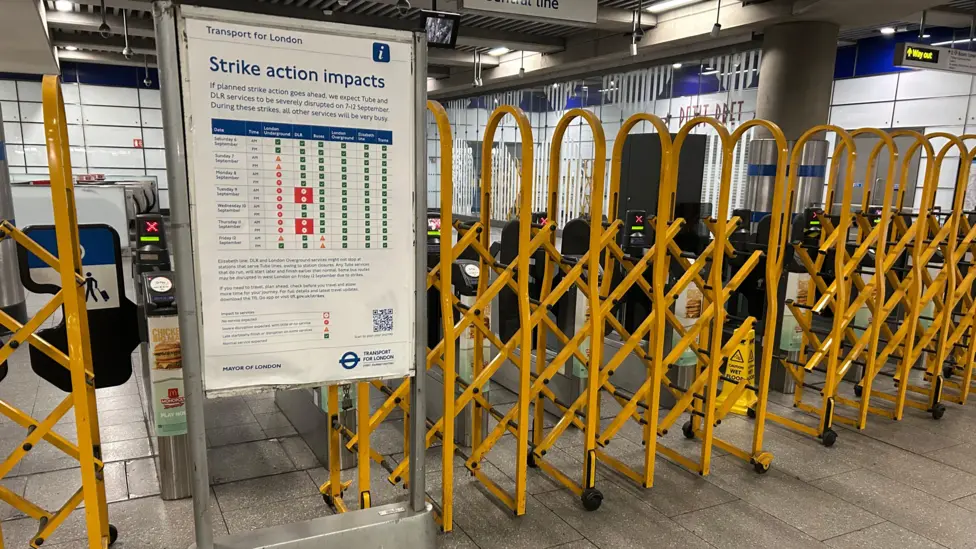
Image © BBC/Harry Low
Another wave of industrial action is due to take place as London Underground drivers walk out in a dispute over the voluntary introduction of a four-day week with condensed hours.
Members of the Rail, Maritime and Transport (RMT) voted to oppose the changes. The union says Transport for London "has not made any attempt to engage in negotiation meetings to resolve this dispute".
TfL described the strikes, which start at 12:00 BST on Tuesday, as "disappointing" and said drivers "can remain on a five-day working pattern".
No service is expected on the Circle and Piccadilly lines or the Metropolitan line between Baker Street and Aldgate and the Central line between White City and Liverpool Street.
A second 24-hour walkout will begin at 12:00 on Thursday, causing disruption into Friday.
Many Tube drivers are set to turn up to work as usual, including members of the Aslef train drivers' trade union - which has accepted the proposals, labelling them "exactly the sort of deal every trade union should be trying to achieve".
An RMT spokesperson said: "Despite promises of talks, TfL has not made any attempt to engage in negotiation meetings to resolve this dispute. London Underground is still pushing implementation plans through a forum that excludes senior managers and union officials, instead of engaging in proper negotiations. Our strike action remains on as we continue to seek a negotiated settlement."
Aslef has agreed to the voluntary compressed four-day week, saying it gives participating drivers an extra 35 days off a year "in return for some fairly minor changes to working conditions".
"It will be the first strike in the history of the trade union movement designed to stop people having a shorter working week and more time off," an Aslef spokesperson said.
Claire Mann, TfL's chief operating officer, said: "It is disappointing that the RMT is planning this strike action despite our best efforts to resolve this dispute. We have been clear that our proposals for a four-day week are designed to improve work-life balance and are entirely voluntary. Any Tube driver who doesn't wish to opt in to the new four-day working pattern and associated changes to working arrangements can remain on a five-day working pattern."
Image © BBC/Harry Low
Another wave of industrial action is due to take place as London Underground drivers walk out in a dispute over the voluntary introduction of a four-day week with condensed hours.
Members of the Rail, Maritime and Transport (RMT) voted to oppose the changes. The union says Transport for London "has not made any attempt to engage in negotiation meetings to resolve this dispute".
TfL described the strikes, which start at 12:00 BST on Tuesday, as "disappointing" and said drivers "can remain on a five-day working pattern".
No service is expected on the Circle and Piccadilly lines or the Metropolitan line between Baker Street and Aldgate and the Central line between White City and Liverpool Street.
A second 24-hour walkout will begin at 12:00 on Thursday, causing disruption into Friday.
Many Tube drivers are set to turn up to work as usual, including members of the Aslef train drivers' trade union - which has accepted the proposals, labelling them "exactly the sort of deal every trade union should be trying to achieve".
An RMT spokesperson said: "Despite promises of talks, TfL has not made any attempt to engage in negotiation meetings to resolve this dispute. London Underground is still pushing implementation plans through a forum that excludes senior managers and union officials, instead of engaging in proper negotiations. Our strike action remains on as we continue to seek a negotiated settlement."
Aslef has agreed to the voluntary compressed four-day week, saying it gives participating drivers an extra 35 days off a year "in return for some fairly minor changes to working conditions".
"It will be the first strike in the history of the trade union movement designed to stop people having a shorter working week and more time off," an Aslef spokesperson said.
Claire Mann, TfL's chief operating officer, said: "It is disappointing that the RMT is planning this strike action despite our best efforts to resolve this dispute. We have been clear that our proposals for a four-day week are designed to improve work-life balance and are entirely voluntary. Any Tube driver who doesn't wish to opt in to the new four-day working pattern and associated changes to working arrangements can remain on a five-day working pattern."
It is interesting how the 'official line' of the train drivers' union ASLEF differs from the stance of the RMT: open criticism, actually.
It is interesting - also worth bearing in mind that the RMT is now led by Eddie Dempsey, a hard left activist who admits to being inspired by Irish terrorists and counts the Leaders of some of Putin's most savage paramilitaries amongst his friends - even writing a glowing obituary to one who was assassinated - how people like this get to lead British Trade Unions God only knows and it's good to see the more practical and pragmatic ASLEF challenging his position.
Good to see this one's been called off (albeit very late for many to change plans) but another once scheduled for a couple of weeks time is just as disruptive.
| Re: London Tube strikes by RMT - ongoing developments in early 2026 Posted by ChrisB at 15:40, 18th May 2026 | |
From Evening Standard, via MSN update
includes....
"The dispute is not over and more strike action will follow if we fail to make sufficient progress."
The RMT also brought forward planned strikes in June, which were due to take place on the 16 and 18.
They are now set to start on Tuesday June 2 and Thursday June 4.
The RMT also brought forward planned strikes in June, which were due to take place on the 16 and 18.
They are now set to start on Tuesday June 2 and Thursday June 4.
| Re: London Tube strikes by RMT - ongoing developments in early 2026 Posted by ChrisB at 15:17, 18th May 2026 | |
From Evening Standard, via MSN
Tube drivers' 4-day week many Londoners would grab but RMT rejects
The RMT union has caused travel misery for Londoners with strikes on the Tube in a dispute over a four-day week.
The “militant” union was due to press ahead with two more rounds of 24-hour walkouts, beginning at 12pm on Tuesday and again at midday on Thursday this week.
But the train drivers’ union Aslef has accepted the deal which has been offered by Transport for London.
The RMT union has caused travel misery for Londoners with strikes on the Tube in a dispute over a four-day week.
The “militant” union was due to press ahead with two more rounds of 24-hour walkouts, beginning at 12pm on Tuesday and again at midday on Thursday this week.
But the train drivers’ union Aslef has accepted the deal which has been offered by Transport for London.
In a memo to members, Finn Brennan, Aslef’s district organiser for the Tube, laid out why the new four-day week would be so good for drivers.
Here is his explanation in full:
The introduction of the 4-day week will be the biggest improvement in working conditions for Underground Train Drivers in decades. It means you will have working conditions that are as good as, or better than, those on any mainline train company.
There has been lots of false information circulated, so it is important that every driver understands the facts about what it means for you.
The 4-day week will be piloted first on the Bakerloo line before rolling out across the combine. Detailed discussions on everything involved are taking place, with both trade unions meeting management every week. When the details are agreed, draft rosters and duty sheets will be produced so that everyone can see exactly what the new working pattern will look like and decide if they want to move to a 4 day week or stay on a 5 day pattern.
The key differences are;
An extra month away from work every year
The 4-day week means you will spend 35 fewer days at work every year. That is more than an extra month off.
Your annual leave entitlement will not change. It will remain at 7.4 working weeks. A week’s leave will now use up only 4 days of your entitlement instead of 5.
An extra rest day each week means roster patterns and duty swaps can be arranged in different ways so you will have more flexibility to block leave together, or take long weekends or mini-breaks if you prefer.
A 32-hour week
Average weekly rostered hours will reduce to 34 hours from the current average of 36.
Your undisturbed meal break will be counted as part of your working hours. Drivers will be the only grade this applies too.
That means you will be working an average 32 hour week, as your rostered hours will be 34 hours less 2 hours (4 x ½ hour meal breaks)
Flexible working arrangements.
There will be no change to your right to request flexible working arrangements. This is a legal entitlement and won’t change in any way.
If you have a flexible working agreement in place, that is not affected by the move to a 4-day week.
Less fatigue
Having a third rest day every week means more time at home and a lot less time spent traveling to and from work. Reducing fatigue and giving you a better quality of life.
As the average rostered week reduces to 34 hours, your longest possible working week will reduce from 42.5 hours now to 38 hours per week. That’s 4.5 hours fewer at work if you do the roughest possible turn all week.
What about Pool Drivers?
Currently all pool drivers are a “line resource” and can work out of any depot on the line. On the 4-day week the majority of pool drivers will be at their home depot only with a partial rest day roster meaning certainty about their shifts and the ability to plan ahead for family commitments etc.
All pool drivers will get an extra rest day every week. And for the first time, one rest day will be rostered in advance so that people can plan ahead.
Saving you money
As well as the time you save traveling to work one day less every week, you will also save money on travel or childcare costs.
There are already 120 drivers across the combine on a four-day week, with over 130 on waiting lists. Instead of only getting 80% of salary, they will have the option of receiving full pay.
Overtime
For the first time drivers will have the opportunity to volunteer for overtime like every other grade.
If you don’t want to work overtime you won’t have to, but you will have the opportunity to make some extra money if you need it, by working one day a week at time and a quarter.
Using an ipad
Instead of having to carry rule books, line information books, DISI and duty books etc, and signing on manually all documents will be available electronically.
The only time you would use it when away from work would be to check duties, just as you would check your diary or messages from syndicates now.
Don't want to do it?
Not a problem. The 4-day week is voluntary. If you want to stay on a 5-day working pattern you can. It's your choice. How this works in practice will be discussed in detail at Trains Council which includes both unions.
The reality is few people will want to keep working an extra day and more hours every week for no extra money and less time off! (After all, why would anyone want to spend more than a month extra at work every year?) But ASLEF will support any member who wants to remain on a five-day working pattern to do so.
The RMT union has caused travel misery for Londoners with strikes on the Tube in a dispute over a four-day week.
The “militant” union was due to press ahead with two more rounds of 24-hour walkouts, beginning at 12pm on Tuesday and again at midday on Thursday this week.
But the train drivers’ union Aslef has accepted the deal which has been offered by Transport for London.
The RMT union has caused travel misery for Londoners with strikes on the Tube in a dispute over a four-day week.
The “militant” union was due to press ahead with two more rounds of 24-hour walkouts, beginning at 12pm on Tuesday and again at midday on Thursday this week.
But the train drivers’ union Aslef has accepted the deal which has been offered by Transport for London.
In a memo to members, Finn Brennan, Aslef’s district organiser for the Tube, laid out why the new four-day week would be so good for drivers.
Here is his explanation in full:
The introduction of the 4-day week will be the biggest improvement in working conditions for Underground Train Drivers in decades. It means you will have working conditions that are as good as, or better than, those on any mainline train company.
There has been lots of false information circulated, so it is important that every driver understands the facts about what it means for you.
The 4-day week will be piloted first on the Bakerloo line before rolling out across the combine. Detailed discussions on everything involved are taking place, with both trade unions meeting management every week. When the details are agreed, draft rosters and duty sheets will be produced so that everyone can see exactly what the new working pattern will look like and decide if they want to move to a 4 day week or stay on a 5 day pattern.
The key differences are;
An extra month away from work every year
The 4-day week means you will spend 35 fewer days at work every year. That is more than an extra month off.
Your annual leave entitlement will not change. It will remain at 7.4 working weeks. A week’s leave will now use up only 4 days of your entitlement instead of 5.
An extra rest day each week means roster patterns and duty swaps can be arranged in different ways so you will have more flexibility to block leave together, or take long weekends or mini-breaks if you prefer.
A 32-hour week
Average weekly rostered hours will reduce to 34 hours from the current average of 36.
Your undisturbed meal break will be counted as part of your working hours. Drivers will be the only grade this applies too.
That means you will be working an average 32 hour week, as your rostered hours will be 34 hours less 2 hours (4 x ½ hour meal breaks)
Flexible working arrangements.
There will be no change to your right to request flexible working arrangements. This is a legal entitlement and won’t change in any way.
If you have a flexible working agreement in place, that is not affected by the move to a 4-day week.
Less fatigue
Having a third rest day every week means more time at home and a lot less time spent traveling to and from work. Reducing fatigue and giving you a better quality of life.
As the average rostered week reduces to 34 hours, your longest possible working week will reduce from 42.5 hours now to 38 hours per week. That’s 4.5 hours fewer at work if you do the roughest possible turn all week.
What about Pool Drivers?
Currently all pool drivers are a “line resource” and can work out of any depot on the line. On the 4-day week the majority of pool drivers will be at their home depot only with a partial rest day roster meaning certainty about their shifts and the ability to plan ahead for family commitments etc.
All pool drivers will get an extra rest day every week. And for the first time, one rest day will be rostered in advance so that people can plan ahead.
Saving you money
As well as the time you save traveling to work one day less every week, you will also save money on travel or childcare costs.
There are already 120 drivers across the combine on a four-day week, with over 130 on waiting lists. Instead of only getting 80% of salary, they will have the option of receiving full pay.
Overtime
For the first time drivers will have the opportunity to volunteer for overtime like every other grade.
If you don’t want to work overtime you won’t have to, but you will have the opportunity to make some extra money if you need it, by working one day a week at time and a quarter.
Using an ipad
Instead of having to carry rule books, line information books, DISI and duty books etc, and signing on manually all documents will be available electronically.
The only time you would use it when away from work would be to check duties, just as you would check your diary or messages from syndicates now.
Don't want to do it?
Not a problem. The 4-day week is voluntary. If you want to stay on a 5-day working pattern you can. It's your choice. How this works in practice will be discussed in detail at Trains Council which includes both unions.
The reality is few people will want to keep working an extra day and more hours every week for no extra money and less time off! (After all, why would anyone want to spend more than a month extra at work every year?) But ASLEF will support any member who wants to remain on a five-day working pattern to do so.
| Re: London Tube strikes by RMT - ongoing developments in early 2026 Posted by Chris from Nailsea at 15:09, 18th May 2026 | |
I have amended the heading of this topic, in view of the RMT's announcement, for clarity.
| Re: London Tube strikes by RMT - ongoing developments in early 2026 Posted by Chris from Nailsea at 15:01, 18th May 2026 | |
An update, from the BBC:
Tube strikes called off by RMT union
A wave of strikes starting on Tuesday by London Underground drivers has been suspended by the Rail, Maritime and Transport (RMT) union.
Drivers were due to walk out at 12:00 BST on Tuesday and resume on Thursday in a dispute over the voluntary introduction of a four-day week with condensed hours.
On Monday, the RMT said "at the 11th hour the employer has shifted its position allowing us to further explore our members concerns around the imposition of new rosters, fatigue and safety issues".
Transport for London (TfL) described the suspension as "good news for London". Industrial action planned for 16 and 18 June has been suspended but fresh strikes have been called for 2 and 4 June.
The voluntary introduction of a four-day week with condensed hours has led the RMT to warn that "the dispute is not over and more strike action will follow if we fail to make sufficient progress".
Nick Dent, director of customer operations for London Underground, said: "We are pleased that RMT has withdrawn its planned industrial action this week. Our proposal for a voluntary four-day week is designed to improve both work-life balance for drivers and the reliability of service for customers. We look forward to further discussions on the implementation of these proposals with all of our trade unions."
No service had been expected on the Circle and Piccadilly lines or parts of the Metropolitan and Central lines. But many Tube drivers were set to turn up to work as usual, including members of the Aslef train drivers' trade union, which has accepted the proposals, labelling them "exactly the sort of deal every trade union should be trying to achieve".
Aslef has agreed to the voluntary compressed four-day week, saying it gives participating drivers an extra 35 days off a year "in return for some fairly minor changes to working conditions".
The RMT had branded it a "fake four-day week that amounts to five days' work compressed into four". Their concerns include reduced flexibility, shift length and resulting fatigue impacting safety.
A wave of strikes starting on Tuesday by London Underground drivers has been suspended by the Rail, Maritime and Transport (RMT) union.
Drivers were due to walk out at 12:00 BST on Tuesday and resume on Thursday in a dispute over the voluntary introduction of a four-day week with condensed hours.
On Monday, the RMT said "at the 11th hour the employer has shifted its position allowing us to further explore our members concerns around the imposition of new rosters, fatigue and safety issues".
Transport for London (TfL) described the suspension as "good news for London". Industrial action planned for 16 and 18 June has been suspended but fresh strikes have been called for 2 and 4 June.
The voluntary introduction of a four-day week with condensed hours has led the RMT to warn that "the dispute is not over and more strike action will follow if we fail to make sufficient progress".
Nick Dent, director of customer operations for London Underground, said: "We are pleased that RMT has withdrawn its planned industrial action this week. Our proposal for a voluntary four-day week is designed to improve both work-life balance for drivers and the reliability of service for customers. We look forward to further discussions on the implementation of these proposals with all of our trade unions."
No service had been expected on the Circle and Piccadilly lines or parts of the Metropolitan and Central lines. But many Tube drivers were set to turn up to work as usual, including members of the Aslef train drivers' trade union, which has accepted the proposals, labelling them "exactly the sort of deal every trade union should be trying to achieve".
Aslef has agreed to the voluntary compressed four-day week, saying it gives participating drivers an extra 35 days off a year "in return for some fairly minor changes to working conditions".
The RMT had branded it a "fake four-day week that amounts to five days' work compressed into four". Their concerns include reduced flexibility, shift length and resulting fatigue impacting safety.
| Re: London Tube strikes by RMT - ongoing developments in early 2026 Posted by ChrisB at 11:36, 18th May 2026 | |
Bus Controllers are also walking out at the same time in another dispute which could affect their running.
| Re: London Tube strikes by RMT - ongoing developments in early 2026 Posted by Chris from Nailsea at 11:33, 18th May 2026 | |
From the BBC:
Tube strike set to go ahead after failed talks
Image © BBC/Harry Low
Another wave of industrial action is due to take place as London Underground drivers walk out in a dispute over the voluntary introduction of a four-day week with condensed hours.
Members of the Rail, Maritime and Transport (RMT) voted to oppose the changes. The union says Transport for London "has not made any attempt to engage in negotiation meetings to resolve this dispute".
TfL described the strikes, which start at 12:00 BST on Tuesday, as "disappointing" and said drivers "can remain on a five-day working pattern".
No service is expected on the Circle and Piccadilly lines or the Metropolitan line between Baker Street and Aldgate and the Central line between White City and Liverpool Street.
A second 24-hour walkout will begin at 12:00 on Thursday, causing disruption into Friday.
Many Tube drivers are set to turn up to work as usual, including members of the Aslef train drivers' trade union - which has accepted the proposals, labelling them "exactly the sort of deal every trade union should be trying to achieve".
An RMT spokesperson said: "Despite promises of talks, TfL has not made any attempt to engage in negotiation meetings to resolve this dispute. London Underground is still pushing implementation plans through a forum that excludes senior managers and union officials, instead of engaging in proper negotiations. Our strike action remains on as we continue to seek a negotiated settlement."
Aslef has agreed to the voluntary compressed four-day week, saying it gives participating drivers an extra 35 days off a year "in return for some fairly minor changes to working conditions".
"It will be the first strike in the history of the trade union movement designed to stop people having a shorter working week and more time off," an Aslef spokesperson said.
Claire Mann, TfL's chief operating officer, said: "It is disappointing that the RMT is planning this strike action despite our best efforts to resolve this dispute. We have been clear that our proposals for a four-day week are designed to improve work-life balance and are entirely voluntary. Any Tube driver who doesn't wish to opt in to the new four-day working pattern and associated changes to working arrangements can remain on a five-day working pattern."
Image © BBC/Harry Low
Another wave of industrial action is due to take place as London Underground drivers walk out in a dispute over the voluntary introduction of a four-day week with condensed hours.
Members of the Rail, Maritime and Transport (RMT) voted to oppose the changes. The union says Transport for London "has not made any attempt to engage in negotiation meetings to resolve this dispute".
TfL described the strikes, which start at 12:00 BST on Tuesday, as "disappointing" and said drivers "can remain on a five-day working pattern".
No service is expected on the Circle and Piccadilly lines or the Metropolitan line between Baker Street and Aldgate and the Central line between White City and Liverpool Street.
A second 24-hour walkout will begin at 12:00 on Thursday, causing disruption into Friday.
Many Tube drivers are set to turn up to work as usual, including members of the Aslef train drivers' trade union - which has accepted the proposals, labelling them "exactly the sort of deal every trade union should be trying to achieve".
An RMT spokesperson said: "Despite promises of talks, TfL has not made any attempt to engage in negotiation meetings to resolve this dispute. London Underground is still pushing implementation plans through a forum that excludes senior managers and union officials, instead of engaging in proper negotiations. Our strike action remains on as we continue to seek a negotiated settlement."
Aslef has agreed to the voluntary compressed four-day week, saying it gives participating drivers an extra 35 days off a year "in return for some fairly minor changes to working conditions".
"It will be the first strike in the history of the trade union movement designed to stop people having a shorter working week and more time off," an Aslef spokesperson said.
Claire Mann, TfL's chief operating officer, said: "It is disappointing that the RMT is planning this strike action despite our best efforts to resolve this dispute. We have been clear that our proposals for a four-day week are designed to improve work-life balance and are entirely voluntary. Any Tube driver who doesn't wish to opt in to the new four-day working pattern and associated changes to working arrangements can remain on a five-day working pattern."
It is interesting how the 'official line' of the train drivers' union ASLEF differs from the stance of the RMT: open criticism, actually.
| Re: London Tube strikes by RMT - ongoing developments in early 2026 Posted by ChrisB at 08:20, 12th March 2026 | |
I think the BBC have it wrong.
Both the Standard & Telegraph report that 24-hour strikes will run
Members of the Rail, Maritime and Transport union (RMT) will walk out at midday on March 24 and 26, April 21 and 23 and May 19 and 21.
So, the BBC seems to be saying that there will be no service after they return to work after midday 26/3, 23/4, 21/5
| London Tube strikes by RMT - ongoing developments in early 2026 Posted by TaplowGreen at 07:35, 12th March 2026 | |
RMT this time
https://www.bbc.co.uk/news/articles/c0ljyd03n88o
