







Recent Public Posts - [guest]
| Re: Bridge hit - again "Freshford" = Limpley Stoke? In "Portsmouth to Cardiff" [377176/32077/20] Posted by ChrisB at 12:08, 18th July 2026 |      |
[snip]
Current Situation
essentially, the main problem is that Network Rail engineers think that the correct height restriction should be 3.9m but Wiltshire Highways think that 4.1m is right.
[snip]
Current Situation
essentially, the main problem is that Network Rail engineers think that the correct height restriction should be 3.9m but Wiltshire Highways think that 4.1m is right.
[snip]
So.....what vehicles would not be restricted by the council, but would be by Network Rail?
(I'm sorry, I don't know the heiht of commercial vehicles)
| Re: Bridge hit - again "Freshford" = Limpley Stoke? In "Portsmouth to Cardiff" [377175/32077/20] Posted by grahame at 12:00, 18th July 2026 | |
And from (Wiltshire) Councillor Nigel White in who's ward THAT bridge lies
https://www.winsley.org.uk/news/a-bridge-too-far-update-from-unitary-cllr-nigel-white
[snip]
Current Situation
It was time to get something done. The strikes continued, every one requiring Network Rail to hold trains until an inspection had been done.
The strike on the 23rd March had caused 38 full and 39 partial train cancellations; this was costing Network Rail serious money, Network Rail wanted something done too, and they were prepared to discuss funding risk mitigation measures. One of the many things suggested by residents to me was some sort of sensor activated sign before Winsley roundabout warning high vehicles to turn around. This option was discussed positively by both parties. The estimated cost would be around £25k. which Network Rail would fund and Wiltshire Highway would install. Network Rail also proposed putting up a temporary electronic sign until a permanent solution was installed. This was sounding like something was going to get done, and it still may, however, new options have entered the discussion, which might produce better results, but they will take longer and cost more. Please read the attached Meeting Notes and supporting slides for details.
Essentially, the main problem is that Network Rail engineers think that the correct height restriction should be 3.9m but Wiltshire Highways think that 4.1m is right.
If that sounds intractable, fear not, Network Rail need to get something done and I’m going to make it my mission to get something done, because residents need something to be done!
[snip]
Current Situation
It was time to get something done. The strikes continued, every one requiring Network Rail to hold trains until an inspection had been done.
The strike on the 23rd March had caused 38 full and 39 partial train cancellations; this was costing Network Rail serious money, Network Rail wanted something done too, and they were prepared to discuss funding risk mitigation measures. One of the many things suggested by residents to me was some sort of sensor activated sign before Winsley roundabout warning high vehicles to turn around. This option was discussed positively by both parties. The estimated cost would be around £25k. which Network Rail would fund and Wiltshire Highway would install. Network Rail also proposed putting up a temporary electronic sign until a permanent solution was installed. This was sounding like something was going to get done, and it still may, however, new options have entered the discussion, which might produce better results, but they will take longer and cost more. Please read the attached Meeting Notes and supporting slides for details.
Essentially, the main problem is that Network Rail engineers think that the correct height restriction should be 3.9m but Wiltshire Highways think that 4.1m is right.
If that sounds intractable, fear not, Network Rail need to get something done and I’m going to make it my mission to get something done, because residents need something to be done!
[snip]
Not only residents need something done - so do rail passengers passing through the area, and those who aren't even in the immediate area but are trying to catch trains that are cancelled or delayed as a result.
| Canadian Wildfire.............. In "The Wider Picture Overseas" [377174/32252/52] Posted by Clan Line at 11:53, 18th July 2026 | |
I think all you can say to this is: "B****y hell" !!!
https://www.bbc.co.uk/news/videos/cwy0yyzdqxvo
| Re: Stonehenge - Love it or hate it? In "The West - but NOT trains in the West" [377173/32211/31] Posted by TaplowGreen at 11:26, 18th July 2026 | |
... as some American visitor is reported to have asked, "Why on Earth did they build Stonehenge so close to the main road?"
CfN.


CfN.


Probably the same chap who was appreciative of Windsor Castle being built so close to Heathrow!
| Re: Stonehenge - Love it or hate it? In "The West - but NOT trains in the West" [377171/32211/31] Posted by Marlburian at 09:59, 18th July 2026 | |
In 1927.
| Re: Stonehenge - Love it or hate it? In "The West - but NOT trains in the West" [377170/32211/31] Posted by grahame at 09:32, 18th July 2026 | |
Hate it !
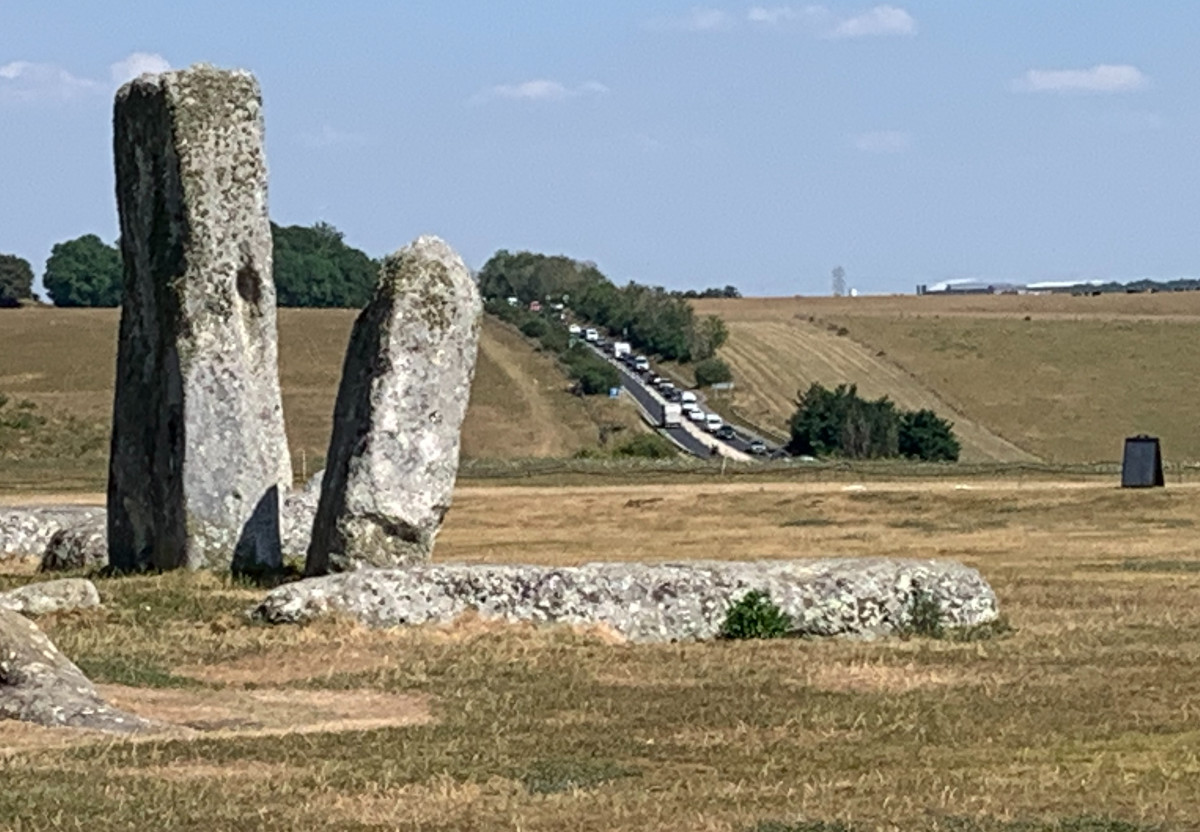
A right royal pain in the *** when you have to drive along the A303, only to be faced with queuing traffic. Why? because the delightful traveller in front of you has slowed down to 15mph while they gawp out the window at the magical marvel. A picturesque rubber-necking you may call it.
The sooner the build a chuffin big hedge in front of it, the better, cause the tunnel is never going to happen !
[rant over]
A right royal pain in the *** when you have to drive along the A303, only to be faced with queuing traffic. Why? because the delightful traveller in front of you has slowed down to 15mph while they gawp out the window at the magical marvel. A picturesque rubber-necking you may call it.
The sooner the build a chuffin big hedge in front of it, the better, cause the tunnel is never going to happen !
[rant over]
Classically illustrated on Thursday - with the traffic from London slowed down to a crawl as it approaches the henge, and traffic London-bound (which should be about the same volume) sparse and flowing freely.
All sorts of ideas for the road have been mooted in the past - has any thought been given to moving the henge to somewhere more convenient for tourists? As I learned from the history panels, we have had the ability to move stones for several millennia ...
| Broken down train - an example of explanation and minimisation of issues In "Shorter journeys in Plymouth and Cornwall" [377169/32251/25] Posted by grahame at 08:50, 18th July 2026 Already liked by PrestburyRoad, Western Pathfinder | |
Cancellations to services between Truro and Falmouth Docks
Due to a broken down train between Truro and Falmouth Docks fewer trains are able to run on the line.
Train services running to and from these stations will be cancelled. Disruption is expected until 10:00 18/07.
Customer Advice
One of the trains planned for use on the Truro to Falmouth Docks service this morning has broken down, with a spare not immediately available.
One has been found, but is not currently in the area to operate the service, therefore until it is, the service is reduced from half hourly to hourly.
During this time, customers can use their tickets on local buses if they prefer. Details below:
Go Cornwall Bus route 32A: Falmouth (The Moor), Penryn, Truro (Bus Station), Truro (Station), Go Cornwall Bus route 32: Falmouth (The Moor), Penryn, Truro (Bus Station), Go Cornwall Bus route 33, 33A: Falmouth (The Moor), Penryn (Station), Redruth (Station) and Go Cornwall Bus route 36, 36A: Truro (Bus Station), Perranwell (Station) are conveying passengers via any reasonable route until further notice. Arrangements have been made for Great Western Railway rail tickets to be accepted for these journeys.
Due to a broken down train between Truro and Falmouth Docks fewer trains are able to run on the line.
Train services running to and from these stations will be cancelled. Disruption is expected until 10:00 18/07.
Customer Advice
One of the trains planned for use on the Truro to Falmouth Docks service this morning has broken down, with a spare not immediately available.
One has been found, but is not currently in the area to operate the service, therefore until it is, the service is reduced from half hourly to hourly.
During this time, customers can use their tickets on local buses if they prefer. Details below:
Go Cornwall Bus route 32A: Falmouth (The Moor), Penryn, Truro (Bus Station), Truro (Station), Go Cornwall Bus route 32: Falmouth (The Moor), Penryn, Truro (Bus Station), Go Cornwall Bus route 33, 33A: Falmouth (The Moor), Penryn (Station), Redruth (Station) and Go Cornwall Bus route 36, 36A: Truro (Bus Station), Perranwell (Station) are conveying passengers via any reasonable route until further notice. Arrangements have been made for Great Western Railway rail tickets to be accepted for these journeys.
1. Good description of the issue
2. It seems reasonable that there isn't a spare train on each line (and heaven help us if reliability was so poor that was needed)
3. This shows the robustness of a two-train service over a one-train one; worst wait is half an hour.
4. Good to offer the bus alternatives. IMHO, rail and bus tickets for the same journey should be interchangeable at all times - who cares whether there are rubber or steel wheels on the vehicle?
| Re: Local government reorganisation across Oxfordshire In "London to Didcot, Oxford and Banbury" [377168/32241/9] Posted by eightonedee at 08:42, 18th July 2026 | |
Heaven help us in any event Sid. From the complaints I hear from friends just over the river/county boundary in Goring and what I read locally, the combined services for South Oxfordshire and the Vale are no better, and as a highway authority (both dealing with repairs and temporary diversions) Oxfordshire County are definitely worse than West Berks.
Sadly, for highways it is likely to be a bleak outlook, with a substantial network of rural roads and tight central Government spending controls. I fear that the new Manchester approach doesn't look likely to be concerned with infrastructure problems in rural central southern England (or ageing railway rolling stock inthe South West, come to think of it).
| Re: Investigation into parking tickets for drivers queuing at petrol stations In "The Wider Picture in the United Kingdom" [377167/32243/51] Posted by eightonedee at 08:30, 18th July 2026 | |
It's not quite thar simple, Jaymac.
Clan Line and all his neighbours need to agree, firstly because a barrier is likely to be an interference with the right of way that each individually enjoys (if so, the objection of just one will defeat the idea). Secondly you need to agree the cost, and if it is not currently covered by the service charge prudently the leases all need to be changed to cover it. If it is any kind of powered barrier you'd also likely need a maintenance contract. After looking into all that the residents might conclude that the occasional inconvenience from an inconsiderate unauthorised parker is less hassle and something they can put up wi3.
| Re: Andy Burnham elected to parliament, with a strong transport reputation In "Looking forward - the next 2, 5, 10 and 20 years" [377166/32149/40] Posted by TaplowGreen at 08:21, 18th July 2026 | |
Some rumours that this somewhat familiar face may be making a comeback as a reward for her efforts on Burnham's behalf......
| Re: Swing Bridges In "Heritage railways, Railtours, buses, canals, steamships and other public transport based attractions" [377164/32250/47] Posted by Bob_Blakey at 07:31, 18th July 2026 | |
Coincidentally I yesterday responded to a public consultation from Devon County Council (DCC) regarding a proposal to replace the two bridges, one swing & one bascule, carrying the A379 over the Exeter Ship Canal. Both are life-expired and, apparently, costing (us) a fortune in maintenance. The preferred solution is the provision of two bascule bridges, rather than a like for like replacement.
I am pleased, but somewhat surprised, to report that in my view the proposed DCC solution makes perfect sense!
| Re: Local government reorganisation across Oxfordshire In "London to Didcot, Oxford and Banbury" [377163/32241/9] Posted by CyclingSid at 07:00, 18th July 2026 | |
Unless West Berks (as an established unitary authority) is simply going to step in and assume the role for all functions currently reserved to the county in Oxfordshire.
In which case heaven help the residents.
There was a (half) sensible suggestion that local government reorganisation should align with the new ICB (Integrated Care Boards), as they will have to jointly manage and fund social care. This will be a test of the new PMs thoughts on improving social care. The relevant ICB in this case is Oxfordshire, Buckinghamshire and Berkshire, not perfect on the Oxford Health Authority history, but probably better than any of the LG suggestions that have been made so far.
| Swing Bridges In "Heritage railways, Railtours, buses, canals, steamships and other public transport based attractions" [377162/32250/47] Posted by grahame at 06:51, 18th July 2026 | |
"On this day" - 18th July 2026 (or was it 17th?) - tells me that the longest Swing Bridge (in the UK)? opened 150 years ago today. As it'sm in Newcastle (not our area) and for road traffic (not trains) it's not had a mention in the Coffee Shop thus far, and I run the risk of being flagged "off topic"
From https://www.theguardian.com/uk-news/2021/aug/22/bid-to-save-river-tyne-swing-bridge-that-just-wont-swing
On 17 July 1876, the world’s largest swinging bridge – a marvel of hydraulic engineering – opened for the first time, allowing access to the upper reaches of the River Tyne.
Since that day, the Newcastle Swing Bridge, designed by William Armstrong, one of the greatest names in British engineering, has opened on about 300,000 occasions for the passage of about half-a-million vessels.
Since that day, the Newcastle Swing Bridge, designed by William Armstrong, one of the greatest names in British engineering, has opened on about 300,000 occasions for the passage of about half-a-million vessels.
But there are, still, some railway swing bridges, and there are still, some swing bridges in our area. And, I will admit, they fascinate me.
Here is a local railway one - alas long gone - from http://www.forgottenrelics.org/bridges/ashton-swing-bridge/
An unusual hydraulically-powered structure built for both road and rail, Ashton swing bridge was erected in 1905-6 for Bristol Corporation and the Great Western Railway. Its chief engineer was J C lnglis and the contractor John Lysaght. Armstrong Whitworth and Co was responsible for the hydraulics.
[snip]
The Whipple Murphy truss moveable span, which has remained shut since February 1934, is 202 feet in length and weighs in at 1,000 tonnes. It could open both ways, with a reversible motor housed in a signal cabin perched above the road deck. The hydraulics drained the dock system of 182 gallons of water every time the bridge opened – and, on average, it did so ten times a day. The mechanism was interlocked with the signal boxes on either side of the river, making it impossible for signals to be cleared unless the span was locked in the closed position.
Bristol Corporation rescinded the railway’s obligation to maintain the swing aparatus in 1951, since which time is has been fixed shut. The road deck and signal cabin were removed following the completion of new local roads in 1965.
[snip]
The Whipple Murphy truss moveable span, which has remained shut since February 1934, is 202 feet in length and weighs in at 1,000 tonnes. It could open both ways, with a reversible motor housed in a signal cabin perched above the road deck. The hydraulics drained the dock system of 182 gallons of water every time the bridge opened – and, on average, it did so ten times a day. The mechanism was interlocked with the signal boxes on either side of the river, making it impossible for signals to be cleared unless the span was locked in the closed position.
Bristol Corporation rescinded the railway’s obligation to maintain the swing aparatus in 1951, since which time is has been fixed shut. The road deck and signal cabin were removed following the completion of new local roads in 1965.
In the British Isles, I remain concerned for the Swing Bridge on the Rosslare to Waterford line, presently locked open to allow river traffic to pass. The line moved from a "parly" servive to mothballed as long as 15 years ago now; reports as recent as the last few days reportn an passage as far as the bridge by a weedkiller train, and this line seems such a missing link on the Irish system. One day, perhaps??
| Re: Routeing Guide - effect of VIAs ? In "Fare's Fair" [377161/32249/4] Posted by Chris from Nailsea at 03:42, 18th July 2026 | |
Cue Justin.

| Re: Class 175s to Great Western Railway (GWR) In "Across the West" [377160/28982/26] Posted by Chris from Nailsea at 03:40, 18th July 2026 | |
Maybe they're just using up all the old tins of paint / vinyl, before they go out of date?

| Re: Rail Customer Experience Survey October 2025 - March 2026 In "The Wider Picture in the United Kingdom" [377159/32248/51] Posted by Chris from Nailsea at 03:33, 18th July 2026 | |
Erm ... I think grahame will.
| Re: Stonehenge - Love it or hate it? In "The West - but NOT trains in the West" [377158/32211/31] Posted by broadgage at 02:03, 18th July 2026 Already liked by Chris from Nailsea | |
... as some American visitor is reported to have asked, "Why on Earth did they build Stonehenge so close to the main road?"
CfN.
CfN.
And without a sufficient car park !
| Routeing Guide - effect of VIAs ? In "Fare's Fair" [377157/32249/4] Posted by Trowres at 00:58, 18th July 2026 | |
Here is a question to test Routeing Guide experts (or anyone who would like a challenge):
I wish to make a journey from station A to station B. Both of these are routeing points.
The Routeing Guide lists only one valid route between A and B, although two other "reasonable" routes exist.
If there is a ticket from A to B with route "Via C" (where C is common to all three possible routes), how are valid routes from A to B via C determined?
Here are possible options:
a) The "via" could only filter out routes from the list of valid routes, so in this case there would still be one valid listed route (plus the shortest route)
b) Valid routes would be determined separately for A to C and C to B
c) Something else.
Anyone know the answer?
| Re: Stonehenge - Love it or hate it? In "The West - but NOT trains in the West" [377156/32211/31] Posted by Chris from Nailsea at 23:48, 17th July 2026 | |
... as some American visitor is reported to have asked, "Why on Earth did they build Stonehenge so close to the main road?"
CfN.
| Re: Investigation into parking tickets for drivers queuing at petrol stations In "The Wider Picture in the United Kingdom" [377155/32243/51] Posted by JayMac at 23:00, 17th July 2026 | |
Private road you say?
Why not have a barrier installation and management of that rather than pay a private parking cowboy?
PPCs only make money AFTER someone has allegedly parked where they shouldn't. Prevent them doing so in the first place.
| Re: Stonehenge - Love it or hate it? In "The West - but NOT trains in the West" [377154/32211/31] Posted by wiltshirebloke at 21:47, 17th July 2026 | |
Hate it !
A right royal pain in the *** when you have to drive along the A303, only to be faced with queuing traffic. Why? because the delightful traveller in front of you has slowed down to 15mph while they gawp out the window at the magical marvel. A picturesque rubber-necking you may call it.
The sooner the build a chuffin big hedge in front of it, the better, cause the tunnel is never going to happen !
[rant over]
| Re: Class 175s to Great Western Railway (GWR) In "Across the West" [377153/28982/26] Posted by TaplowGreen at 21:39, 17th July 2026 | |
Posted on X
Click on the link to view the photo.....and its NOT in GBR colours either. Possibly the very last in GWR....
The first @GWRHelp Class 175 has been repainted in GWR livery - this is set 175103, seen here being shunted by 08629 at Wolverton Works prior to delivery to GWR.
Click on the link to view the photo.....and its NOT in GBR colours either. Possibly the very last in GWR....
What an utter waste of money.
Painting a train in the livery of a TOC that will cease to exist in less than 5 months. Why not paint it in GBR colours?
| Rail Customer Experience Survey October 2025 - March 2026 In "The Wider Picture in the United Kingdom" [377152/32248/51] Posted by ChrisB at 21:22, 17th July 2026 | |
From Transport Focus
The Rail Customer Experience Survey (RCXS) is a new, industry-wide survey of rail passengers’ journeys. Its aim is to provide regular, robust, and consistent customer insight data to the rail industry.
This report covers the headline results from mid-October 2025 to end of March 2026.
Access the full data sets for this release
https://www.transportfocus.org.uk/rail-customer-experience-survey-full-data-sets/
This report covers the headline results from mid-October 2025 to end of March 2026.
Access the full data sets for this release
https://www.transportfocus.org.uk/rail-customer-experience-survey-full-data-sets/
Who fancies chewing the figures?
| London Stansted to trial overnight trains for first time this summer In "The Wider Picture in the United Kingdom" [377151/32247/51] Posted by ChrisB at 21:19, 17th July 2026 | |
From The Independent, via MSN
Stansted Express will trial overnight train services connecting the airport to central London this summer.
Between 3 July and 25 September, additional rail services will run each Friday night into Saturday morning.
During the trial, trains will run approximately every 30 minutes between 11.50pm and 5am from Stansted airport and Tottenham Hale or London Liverpool Street station.
The journey between Stansted airport and Tottenham Hale takes travellers around 36 minutes.
From Tottenham Hale, passengers can take the Victoria line Night Tube for onward travel across London.
Operator of Stansted Express, Greater Anglia, said that joint planning with Network Rail Anglia had allowed the trial to “understand customer demand for overnight airport rail services”.
Greater Anglia was nationalised last autumn ahead of the formal establishment of the government’s Great British Railways in 2027.
The rail minister, Lord Peter Hendy, said: “These overnight Stansted Express services will make a real difference to people arriving late or travelling for early flights – connecting them straight into London via the Night Tube. Alongside contactless ticketing at every London airport, we're building a railway that works for passengers and drives growth across the country.”
Contactless pay-as-you-go was introduced at Stansted airport in March to make travel to the aviation hub “simpler and more flexible”.
Gareth Powell, London Stansted’s managing director, said: “The overnight trial of Friday Stansted Express services is a welcome development, and one which I’m sure will prove to be popular with airport passengers and staff, providing more choice, convenience and connectivity when accessing the airport.”
Standard Stansted Express tickets will be valid for the late-night services, with Railcards and discounts applied as usual.
Between 3 July and 25 September, additional rail services will run each Friday night into Saturday morning.
During the trial, trains will run approximately every 30 minutes between 11.50pm and 5am from Stansted airport and Tottenham Hale or London Liverpool Street station.
The journey between Stansted airport and Tottenham Hale takes travellers around 36 minutes.
From Tottenham Hale, passengers can take the Victoria line Night Tube for onward travel across London.
Operator of Stansted Express, Greater Anglia, said that joint planning with Network Rail Anglia had allowed the trial to “understand customer demand for overnight airport rail services”.
Greater Anglia was nationalised last autumn ahead of the formal establishment of the government’s Great British Railways in 2027.
The rail minister, Lord Peter Hendy, said: “These overnight Stansted Express services will make a real difference to people arriving late or travelling for early flights – connecting them straight into London via the Night Tube. Alongside contactless ticketing at every London airport, we're building a railway that works for passengers and drives growth across the country.”
Contactless pay-as-you-go was introduced at Stansted airport in March to make travel to the aviation hub “simpler and more flexible”.
Gareth Powell, London Stansted’s managing director, said: “The overnight trial of Friday Stansted Express services is a welcome development, and one which I’m sure will prove to be popular with airport passengers and staff, providing more choice, convenience and connectivity when accessing the airport.”
Standard Stansted Express tickets will be valid for the late-night services, with Railcards and discounts applied as usual.
| Cumbria Travel Pass to simplify sustainable travel across the Lake District In "Fare's Fair" [377150/32246/4] Posted by ChrisB at 21:12, 17th July 2026 | |
From Interchange
A new integrated ticket allowing unlimited travel by train, bus and boat across Cumbria has been launched in a move aimed at making it easier for visitors to explore the Lake District without relying on private cars.
The Cumbria Travel Pass, introduced by Northern in partnership with Avanti West Coast, TransPennine Express, Stagecoach and Windermere Lake Cruises, offers unlimited travel for one day (£40) or three consecutive days (£99). Arguably one of the most comprehensive multimodal ticketing products currently available in England, the ticket also includes discounts on selected visitor attractions and lake transport services.
The pass is valid on Northern, Avanti West Coast and TransPennine Express rail services within Cumbria, Stagecoach bus services across the county and scheduled Windermere Lake Cruises. It also provides discounted travel on attractions including the Ravenglass and Eskdale Railway, Coniston Launch, Keswick Launch and Ullswater Steamers.
Northern said the initiative is designed to simplify travel by allowing passengers to use a single ticket across multiple transport modes rather than purchasing separate rail, bus and boat tickets. The operator said tickets can be bought up to 11 months in advance, with Railcard discounts available and reduced fares for children.
Alex Hornby, Commercial and Customer Director at Northern, said, "We're excited to launch this new travel pass. It gives customers real flexibility and peace of mind as they switch between providers, travelling by train, bus and boat – and saves money for those who would usually buy separate tickets for each.
"It’s ideal for anyone looking to travel across this beautiful part of the world, as they can hop on and off at any stop."
The launch supports wider efforts to encourage more sustainable tourism in the Lake District, where seasonal road congestion and parking demand remain significant challenges. By integrating public transport services across different operators, the partners hope to make car-free travel a more practical option for both visitors and residents.
Sue Clarke, Marketing Manager at Cumbria Tourism, said the new ticket aligns with the county's long-term visitor strategy. "This is such great news for our visitors and residents, making it even easier for them to explore our stunning county car free.
"Cumbria's Destination Management Plan sets an ambition for Cumbria to be a leading sustainable and accessible destination, and joining our rail, bus and boat travel together in this way helps make planning simpler."
The Cumbria Travel Pass, introduced by Northern in partnership with Avanti West Coast, TransPennine Express, Stagecoach and Windermere Lake Cruises, offers unlimited travel for one day (£40) or three consecutive days (£99). Arguably one of the most comprehensive multimodal ticketing products currently available in England, the ticket also includes discounts on selected visitor attractions and lake transport services.
The pass is valid on Northern, Avanti West Coast and TransPennine Express rail services within Cumbria, Stagecoach bus services across the county and scheduled Windermere Lake Cruises. It also provides discounted travel on attractions including the Ravenglass and Eskdale Railway, Coniston Launch, Keswick Launch and Ullswater Steamers.
Northern said the initiative is designed to simplify travel by allowing passengers to use a single ticket across multiple transport modes rather than purchasing separate rail, bus and boat tickets. The operator said tickets can be bought up to 11 months in advance, with Railcard discounts available and reduced fares for children.
Alex Hornby, Commercial and Customer Director at Northern, said, "We're excited to launch this new travel pass. It gives customers real flexibility and peace of mind as they switch between providers, travelling by train, bus and boat – and saves money for those who would usually buy separate tickets for each.
"It’s ideal for anyone looking to travel across this beautiful part of the world, as they can hop on and off at any stop."
The launch supports wider efforts to encourage more sustainable tourism in the Lake District, where seasonal road congestion and parking demand remain significant challenges. By integrating public transport services across different operators, the partners hope to make car-free travel a more practical option for both visitors and residents.
Sue Clarke, Marketing Manager at Cumbria Tourism, said the new ticket aligns with the county's long-term visitor strategy. "This is such great news for our visitors and residents, making it even easier for them to explore our stunning county car free.
"Cumbria's Destination Management Plan sets an ambition for Cumbria to be a leading sustainable and accessible destination, and joining our rail, bus and boat travel together in this way helps make planning simpler."
| Re: Andy Burnham elected to parliament, with a strong transport reputation In "Looking forward - the next 2, 5, 10 and 20 years" [377149/32149/40] Posted by ChrisB at 21:10, 17th July 2026 | |
From the I paper
Burnham’s HS2 promise is dead on arrival – here’s how to really fix Britain’s railways
Just south of Wigan, you find the “flashes”, lakes formed by mining subsidence, once surrounded by Somme-like industrial wasteland, now transformed into rural nature reserves and a refuge for the willow tit, Britain’s most threatened bird. A tenth of this species’ entire UK population lives around the flashes, but perhaps not for much longer.
The area is also home to an even more rare creature than the willow tit: a Labour by-election winner, Andy Burnham, whose constituency, Makerfield, this is. And when he becomes prime minister, he wants to drive a new high-speed railway right through it.
Burnham pledged to reinstate HS2’s second phase, between the West Midlands and the North West, in an interview with The i Paper last month. As well as the route to Manchester, Phase 2 also includes the “Golborne link”, a branch for trains to Preston and Scotland, joining the West Coast Main Line at Bamfurlong, in Burnham’s seat. There was, he said, “a cleverer way of funding” Phase 2 through “contributions from business and residents” or “the increase in land values created by the [new] infrastructure… captured to pay back the cost”.
Henri Murison, of the Northern Powerhouse Partnership, a lobby group for high-speed rail, says a “make-do and mend approach doesn’t work – you end up having to build new lines anyway”. A “significant proportion” of costs could be raised privately, Murison adds, or through measures such as devolved income tax, though he won’t say how much.
But the sums required are genuinely massive. Officially, HS2’s first phase, from London to the Midlands, is now costing between £626m and £734m a mile. On this basis, Phase 2, 89 miles with the Golborne link, would cost up to £65bn. In practice, it should be slightly cheaper, since there is less tunnelling – around 17 per cent of the route, versus 23 per cent in Phase 1 – and fewer cuttings. But that assumes that HS2’s costs rise no further: bold, given its record.
Burnham also wants an underground station in central Manchester – another £5bn on the bill. And he backs a second new line, Northern Powerhouse Rail (NPR) from Liverpool to Manchester and possibly Leeds. NPR shares some of HS2’s track, but even with this, the price for all the schemes together will be perhaps £80bn.
In 2024, Burnham claimed Phase 2 could save up to 40 per cent by becoming “HS2 Lite”, with a top speed of 185mph, not the planned 250mph. The main reason faster is more expensive is that the route must be flatter and straighter, with more earth moved. But HS2 Lite doesn’t change the route, so this saving isn’t available.
Even HS2’s most strident supporters were unconvinced by the plan. The rail commentator, Gareth Dennis, said it was “bad,” “technically illiterate” and “based on several severely misjudged ideas about costs. Suggesting that anything other than the full and original HS2 design will be cheaper and quicker to deliver is wrong.”
As for Burnham’s “cleverer way of funding”, it’s quite true that extra taxes on London business and a “community infrastructure levy” for increased land values did pay for about a quarter of the Elizabeth Line, £4.7bn. The developers of Battersea Power Station similarly funded about a fifth of the cost of extending the Northern Line to their site – £260m (though in return they got changes which raised its price, cancelling out much of their contribution).
But these were far smaller, cheaper projects than HS2. And even for those sorts of schemes, LSE Professor Tony Travers, who chaired a commission on land value capture for infrastructure, says there is “no way any other part of the country could do anything like [London]. Their economies are just not big enough to bear it. The land values are not enough to raise more than a very modest, gestural amount”. As mayor of Greater Manchester, Burnham had power to levy a Crossrail-style supplementary business rate, but never did, presumably for that reason. In the by-election, he promised to cut business taxes.
The final, clinching difficulty is that neither HS2 nor NPR actually fixes the North’s rail problems. University of Liverpool Professor Ian Wray, former chief planner of the Northwest Development Agency, was the first person to propose what became NPR. But now, he says, HS2 and NPR are “projects looking for a plan”, “conceived, designed and delivered in isolation” and “likely to fail to achieve their objectives”.
Writing with David Thrower, another planner, and Jim Steer, one of the earliest high-speed lobbyists, Wray says the North’s rail capacity problem is not on links – lines between places – but at nodes, places where the trains converge, above all central Manchester. Delays from congestion there ripple out across the region, but fixing it is, they say, a “total lacuna” in current plans.
NPR and HS2 will, of course, take some trains off the congested conventional lines in central Manchester – but only about 25 per cent of them. Trevor Parkin, an engineer who has closely studied HS2 and NPR, says building an Elizabeth Line-style scheme under the city centre instead, a short tunnel linking all the conventional lines either side, would increase capacity by at least 100 per cent.
“It would give Burnham his underground station at Piccadilly, it would link to most of the Northern network rather than a handful of places on a high-speed line, and it would cost a fraction of the price,” Parkin says.
There is cross-party momentum behind this concept, from my own think-tank Policy Exchange to the more left-wing Centre for British Progress. New Elizabeth Lines – not just for Manchester, but for every major city – are the top suggestion of 20 “big ideas” for Burnham’s first 100 days, collected by the progressive website Arguably.
As for the problem that HS2 is meant to fix – congestion on the West Coast Main Line – that too could be solved far quicker and cheaper by tackling two pinch points, Crewe and Colwich, than by building a whole new line. This would also prevent services to other places on the existing route, such as Stoke, Stockport, Wilmslow – and Burnham’s own local station at Wigan – being damaged, sometimes devastated, as trains are switched to HS2.
“Every week and every pound we waste on unaffordable high-speed schemes that will never happen is time and money not spent on things which can actually be delivered and would actually transform rail in the North,” says Parkin. “Unless we realise this, we will spend another 10 years achieving nothing.”
Just south of Wigan, you find the “flashes”, lakes formed by mining subsidence, once surrounded by Somme-like industrial wasteland, now transformed into rural nature reserves and a refuge for the willow tit, Britain’s most threatened bird. A tenth of this species’ entire UK population lives around the flashes, but perhaps not for much longer.
The area is also home to an even more rare creature than the willow tit: a Labour by-election winner, Andy Burnham, whose constituency, Makerfield, this is. And when he becomes prime minister, he wants to drive a new high-speed railway right through it.
Burnham pledged to reinstate HS2’s second phase, between the West Midlands and the North West, in an interview with The i Paper last month. As well as the route to Manchester, Phase 2 also includes the “Golborne link”, a branch for trains to Preston and Scotland, joining the West Coast Main Line at Bamfurlong, in Burnham’s seat. There was, he said, “a cleverer way of funding” Phase 2 through “contributions from business and residents” or “the increase in land values created by the [new] infrastructure… captured to pay back the cost”.
Henri Murison, of the Northern Powerhouse Partnership, a lobby group for high-speed rail, says a “make-do and mend approach doesn’t work – you end up having to build new lines anyway”. A “significant proportion” of costs could be raised privately, Murison adds, or through measures such as devolved income tax, though he won’t say how much.
But the sums required are genuinely massive. Officially, HS2’s first phase, from London to the Midlands, is now costing between £626m and £734m a mile. On this basis, Phase 2, 89 miles with the Golborne link, would cost up to £65bn. In practice, it should be slightly cheaper, since there is less tunnelling – around 17 per cent of the route, versus 23 per cent in Phase 1 – and fewer cuttings. But that assumes that HS2’s costs rise no further: bold, given its record.
Burnham also wants an underground station in central Manchester – another £5bn on the bill. And he backs a second new line, Northern Powerhouse Rail (NPR) from Liverpool to Manchester and possibly Leeds. NPR shares some of HS2’s track, but even with this, the price for all the schemes together will be perhaps £80bn.
In 2024, Burnham claimed Phase 2 could save up to 40 per cent by becoming “HS2 Lite”, with a top speed of 185mph, not the planned 250mph. The main reason faster is more expensive is that the route must be flatter and straighter, with more earth moved. But HS2 Lite doesn’t change the route, so this saving isn’t available.
Even HS2’s most strident supporters were unconvinced by the plan. The rail commentator, Gareth Dennis, said it was “bad,” “technically illiterate” and “based on several severely misjudged ideas about costs. Suggesting that anything other than the full and original HS2 design will be cheaper and quicker to deliver is wrong.”
As for Burnham’s “cleverer way of funding”, it’s quite true that extra taxes on London business and a “community infrastructure levy” for increased land values did pay for about a quarter of the Elizabeth Line, £4.7bn. The developers of Battersea Power Station similarly funded about a fifth of the cost of extending the Northern Line to their site – £260m (though in return they got changes which raised its price, cancelling out much of their contribution).
But these were far smaller, cheaper projects than HS2. And even for those sorts of schemes, LSE Professor Tony Travers, who chaired a commission on land value capture for infrastructure, says there is “no way any other part of the country could do anything like [London]. Their economies are just not big enough to bear it. The land values are not enough to raise more than a very modest, gestural amount”. As mayor of Greater Manchester, Burnham had power to levy a Crossrail-style supplementary business rate, but never did, presumably for that reason. In the by-election, he promised to cut business taxes.
The final, clinching difficulty is that neither HS2 nor NPR actually fixes the North’s rail problems. University of Liverpool Professor Ian Wray, former chief planner of the Northwest Development Agency, was the first person to propose what became NPR. But now, he says, HS2 and NPR are “projects looking for a plan”, “conceived, designed and delivered in isolation” and “likely to fail to achieve their objectives”.
Writing with David Thrower, another planner, and Jim Steer, one of the earliest high-speed lobbyists, Wray says the North’s rail capacity problem is not on links – lines between places – but at nodes, places where the trains converge, above all central Manchester. Delays from congestion there ripple out across the region, but fixing it is, they say, a “total lacuna” in current plans.
NPR and HS2 will, of course, take some trains off the congested conventional lines in central Manchester – but only about 25 per cent of them. Trevor Parkin, an engineer who has closely studied HS2 and NPR, says building an Elizabeth Line-style scheme under the city centre instead, a short tunnel linking all the conventional lines either side, would increase capacity by at least 100 per cent.
“It would give Burnham his underground station at Piccadilly, it would link to most of the Northern network rather than a handful of places on a high-speed line, and it would cost a fraction of the price,” Parkin says.
There is cross-party momentum behind this concept, from my own think-tank Policy Exchange to the more left-wing Centre for British Progress. New Elizabeth Lines – not just for Manchester, but for every major city – are the top suggestion of 20 “big ideas” for Burnham’s first 100 days, collected by the progressive website Arguably.
As for the problem that HS2 is meant to fix – congestion on the West Coast Main Line – that too could be solved far quicker and cheaper by tackling two pinch points, Crewe and Colwich, than by building a whole new line. This would also prevent services to other places on the existing route, such as Stoke, Stockport, Wilmslow – and Burnham’s own local station at Wigan – being damaged, sometimes devastated, as trains are switched to HS2.
“Every week and every pound we waste on unaffordable high-speed schemes that will never happen is time and money not spent on things which can actually be delivered and would actually transform rail in the North,” says Parkin. “Unless we realise this, we will spend another 10 years achieving nothing.”
| Re: Railways Bill 2025: introducing and designing Great British Railways - general topic In "Looking forward - the next 2, 5, 10 and 20 years" [377148/31038/40] Posted by ChrisB at 21:06, 17th July 2026 | |
From the Telegraph, via MSN
Safety warning over Labour’s rail nationalisation plans
Labour’s plans to nationalise the railways threaten to undermine passenger safety, the industry watchdog has warned.
The Office of Rail and Road (ORR) said the upheaval of bringing train operators and Network Rail under state control meant senior railway executives could lose focus and start to ignore safety issues.
Great British Railways (GBR), the new state-backed operator, is taking back rail line franchises as they come up for renewal, with remaining routes expected to come under government control by the end of next year.
However, Richard Hines, the chief inspector of railways, said in the ORR’s annual report on health and safety that the disruption of nationalisation could bring short-term risks.
“GBR is an opportunity to strengthen safety across the network but change must not weaken protections or blur who is responsible for keeping passengers and workers safe,” he said.
“As rail reform progresses, there must be clear leadership, clear accountability and a relentless focus on known safety issues, such as over-speeding.”
Richard Holden, the shadow transport secretary, said the warnings from Mr Hines were “concerning” and urged Labour to review its timetable for nationalisation.
He said the findings added to concerns about the impact of the GBR plan, which the Conservatives have claimed will drive up costs and leave passengers and taxpayers to pick up the bill.
“The chief inspector of railways has warned that Labour’s reforms risk weakening accountability for rail safety,” he told The Telegraph.
“Safety must always come first. If the evidence shows that Labour’s rushed nationalisation is compromising the safety of passengers and railway staff, it should be paused until ministers can guarantee those risks have been addressed.”
In its report, the ORR also warned that work to tackle deaths on level crossings, worker fatalities and over-speeding at junctions – recent cases of which had come close to “catastrophic outcomes” – should not take a back seat to the creation of GBR.
The regulator said the crash near Bedford last month – which killed a driver and sent 100 passengers to hospital after a stationary train was hit by another travelling at 50mph – had provided a “sobering reminder” of the severe consequences of rail accidents.
The ORR said that while progress had been made in some areas, “the management of risk is not yet delivering the overall level of control and assurance required”.
The regulator singled out over-speeding, in which trains travel faster than the permitted limit for a given section of track, as one of the most significant safety issues.
Mr Hines also said the safety of maintenance staff remains a key concern after a spate of deaths, including one in March when a track worker was killed after being hit by a train at 110mph.
Fatalities on level crossings are also increasing, he said, while the derailment of an express train following a landslide at Shap, Cumbria, indicated the increased importance of “robust infrastructure management in the face of environmental pressures”.
He said the causes of the Bedford collision remain under investigation.
Initial findings suggested the driver who was killed passed a red signal after the train in front came to an unexpected halt when a fault triggered its emergency braking system.
A Department for Transport spokesman said: “Safety on our railways is our number one priority.
“We have been working with industry and independent experts, including the ORR, to make sure safety is at the heart of everything we do as we set up Great British Railways.
“Our rail reform programme will not change the robust rules in place on safety and as we move forward, we will build on the decades of experience which have meant Britain’s railways consistently rank among the safest in the world.”
Labour’s plans to nationalise the railways threaten to undermine passenger safety, the industry watchdog has warned.
The Office of Rail and Road (ORR) said the upheaval of bringing train operators and Network Rail under state control meant senior railway executives could lose focus and start to ignore safety issues.
Great British Railways (GBR), the new state-backed operator, is taking back rail line franchises as they come up for renewal, with remaining routes expected to come under government control by the end of next year.
However, Richard Hines, the chief inspector of railways, said in the ORR’s annual report on health and safety that the disruption of nationalisation could bring short-term risks.
“GBR is an opportunity to strengthen safety across the network but change must not weaken protections or blur who is responsible for keeping passengers and workers safe,” he said.
“As rail reform progresses, there must be clear leadership, clear accountability and a relentless focus on known safety issues, such as over-speeding.”
Richard Holden, the shadow transport secretary, said the warnings from Mr Hines were “concerning” and urged Labour to review its timetable for nationalisation.
He said the findings added to concerns about the impact of the GBR plan, which the Conservatives have claimed will drive up costs and leave passengers and taxpayers to pick up the bill.
“The chief inspector of railways has warned that Labour’s reforms risk weakening accountability for rail safety,” he told The Telegraph.
“Safety must always come first. If the evidence shows that Labour’s rushed nationalisation is compromising the safety of passengers and railway staff, it should be paused until ministers can guarantee those risks have been addressed.”
In its report, the ORR also warned that work to tackle deaths on level crossings, worker fatalities and over-speeding at junctions – recent cases of which had come close to “catastrophic outcomes” – should not take a back seat to the creation of GBR.
The regulator said the crash near Bedford last month – which killed a driver and sent 100 passengers to hospital after a stationary train was hit by another travelling at 50mph – had provided a “sobering reminder” of the severe consequences of rail accidents.
The ORR said that while progress had been made in some areas, “the management of risk is not yet delivering the overall level of control and assurance required”.
The regulator singled out over-speeding, in which trains travel faster than the permitted limit for a given section of track, as one of the most significant safety issues.
Mr Hines also said the safety of maintenance staff remains a key concern after a spate of deaths, including one in March when a track worker was killed after being hit by a train at 110mph.
Fatalities on level crossings are also increasing, he said, while the derailment of an express train following a landslide at Shap, Cumbria, indicated the increased importance of “robust infrastructure management in the face of environmental pressures”.
He said the causes of the Bedford collision remain under investigation.
Initial findings suggested the driver who was killed passed a red signal after the train in front came to an unexpected halt when a fault triggered its emergency braking system.
A Department for Transport spokesman said: “Safety on our railways is our number one priority.
“We have been working with industry and independent experts, including the ORR, to make sure safety is at the heart of everything we do as we set up Great British Railways.
“Our rail reform programme will not change the robust rules in place on safety and as we move forward, we will build on the decades of experience which have meant Britain’s railways consistently rank among the safest in the world.”
