







Recent Public Posts - [guest]
| Re: Industrial Heritage in Wiltshire conference majoring on railways - 24.10.2026 In "Diary - what's happening when?" [381386/32578/34] Posted by Chris from Nailsea at 22:30, 27th October 2026 |      |
No, I didn't go for such an £18.50 'stroll', in the end. I'm sure they still managed very well without me.

| Re: Storms Austen and Boelo, with following strong winds: modified rail services and infrastructure In "Across the West" [381385/32650/26] Posted by Chris from Nailsea at 22:15, 27th October 2026 | |
I take your point, ChrisB.
I have therefore amended (yet again) the heading of this topic.
CfN.

| Re: Good joined up support - freight, passenger services, govt policy, and our MP In "TransWilts line - Swindon, Chippenham, Westbury" [381384/32666/18] Posted by Chris from Nailsea at 22:03, 27th October 2026 | |
A service with gaps significantly longer than an hour only works for a very small proportion of people (and - Melksham note - that's a gap between when trains run and not when they are timetabled but get cancelled as both the 08:02 and 10:02 were this morning).
I know: that's why I got the excellent Faresaver X34 10:27 bus service from Melksham into Chippenham this morning - and free, with my 'old git' bus pass.


| Re: To 'stockpile food' is now our Government's official policy, apparently In "The West - but NOT trains in the West" [381383/32456/31] Posted by Oxonhutch at 21:53, 27th October 2026 | |
With respect, you are rather assuming that the loft's water container will survive the 'survival incident'.
Personally, I would prefer the basement. Big problem:- I don't have a basement; nor a hectare out the back to dig a bunker.
I live within 2 miles of an active secret RAF base, that mainly flies helicopters, and I expect it to be high on the target list of our country's enemies. I know it is here, and its co-ordinates, and so does Ivan.
My food stockpile will be accessed if: 1: Ivan's rockets have had all of their guidance systems reservoirs depleted of their operational ethanol operating environment (oh, and also tritium with its rather short half life), 2: their rocket propulsion systems work as originally planned (given years of planned maintenance), and 3: their navigation is top notch (dodgy from past performance).
I will be either Ground Zero or looking for window glass replacement.
I have a wind-up radio.
But most of all, a sensible view of what happens if the balloon goes up. My initial survival might be the worst option..
| Re: Storms Austen and Boelo, with following strong winds: modified rail services and infrastructure issues In "Across the West" [381382/32650/26] Posted by ChrisB at 21:16, 27th October 2026 | |
I do note your point, ChrisB, but most of the Scottish press, in particular, have already chosen to name it Chloe.
See the Scottish Daily Express, STV News, Edinburgh News, Yahoo News UK, The National Scot and The Herald Scotland - just for example.
I only quote here what is reported by them: I don't decide whether the content of their news item is accurate - or otherwise.
See the Scottish Daily Express, STV News, Edinburgh News, Yahoo News UK, The National Scot and The Herald Scotland - just for example.
I only quote here what is reported by them: I don't decide whether the content of their news item is accurate - or otherwise.
In cases like these, where the professionals actually do the naming, I would strongly suggest that we report what they do, not what the press would like them to do!
| Re: Historical Record Perception - Correction / Confirmation Required In "South Western services" [381381/32665/42] Posted by Ralph Ayres at 20:54, 27th October 2026 | |
I've never understood how singling an existing line gives any significant saving, except in the short-term if track needs imminent replacement or a problem such as subsidence can be avoided by taking one track out of use. Longer term there will be minor savings such as less track to inspect, but double track would broadly deteriorate at half the speed with each line only having half the usage, and the track is less complex with fewer sets of points to maintain or go wrong at passing places. Knock-on delays if one train is late and more widely the lack of flexibility in timetabling when trains can only pass at specific points on single tracks will also incur costs.
| Re: To 'stockpile food' is now our Government's official policy, apparently In "The West - but NOT trains in the West" [381380/32456/31] Posted by broadgage at 20:27, 27th October 2026 | |
I was only 9 years old in early 1974 when the three day week and rolling power cuts were on, so apart from candles and the camping stove being used, can't really remember what else we did.
Our current newer house doesn't have a cold water tank in loft, but as we are in lower part of town, hopefully mains water won't run dry quickly. Nowadays our heating is electrically controlled but house is better insulated so will stay warm for few days if it shuts down.
It is possible to install a reserve water supply, using cheap mains water, do this as follows.
Install a cold water tank in the loft, filled automatically from the mains water supply via a ball valve.
Connect an outlet this tank about half way up, use this to supply toilet flushing and the washing machine this will ensure regular use of the water and avoid stagnation.
Connect a second outlet near the bottom of the tank, and use microbore copper pipe, supply a hidden tap for reserve drinking water. Copper pipe is preferable to plastic as it is slightly anti bacterial.
This innvolves a fair bit of DIY but it ensures a reserve of fresh water forever.
| Re: Historical Record Perception - Correction / Confirmation Required In "South Western services" [381379/32665/42] Posted by bradshaw at 20:03, 27th October 2026 Already liked by Mark A, PhilWakely | |
Born in Crewkerne and lived there until the late 1960s. My recollection that the WR took over the running of the train service at the change of timetable in autumn 1964. One week it was virtually all steam bar a couple of services. With the timetable change in September the Warships had taken over, with a couple of other working by Hymek and dmu. The two surveys we took seem to confirm that.
The Warships were working over the line before that. In August 1964, D816 was on the 07.30 Exeter Waterloo on the 29th of August. On the same date the 09.30 Exmouth -Waterloo was hauled by D831. The 10.33 Exeter-Yeovil was a dmu, as was its return working to Exeter. D831 returned on the Brighton Plymouth, changing from a Pacific at Salisbury. D816 returned on the 13.00 Waterloo. The Yeovil shuttle was 6430. (Traffic survey at Yeovil Junction 07.30 to 21.44)
On December 24 1964 at Salisbury from 08.20 to 17.00.
D816 06.20 Exd to Wat, D824 07.30 Exd to Wat, D804 09.00 Wat to Exd, dmu 09.48 Exd to Sal, D810 10.30 Exd to Sal and 34051 to Wat. D869 11.00 Wat to Exd, D813 Brighton to Plymouth (34039 from Brighton). Dmu 10.05 Okehampton to Salisbury, D816 13.00 Wat to Exd, D7046 10.55 Plymouth to Brighton/Portsmouth, change to 34039 at Salisbury. Train to Ilfracombe at 16.20 34012 change to D7046 to the west. D815 14.30 Exd to Wat. D824 15.00 Wat to Exd
All the SR services were steam hauled.
Feinnes p99 onwards gives his side of the story.
Singling took place in 1967 but it was realised that more double track was needed. Luckily the line between Yeovil and Templecombe was still double track so the closed line was reopened.
http://www.trainweb.org/railwest/railco/sr/se1967.html for further detail.
| Re: Thames Valley infrastructure problems causing disruption elsewhere - 2026 In "Across the West" [381378/31163/26] Posted by TaplowGreen at 19:44, 27th October 2026 | |
Delays to services between London Paddington and Reading
Following trespassers on the railway between London Paddington and Reading all lines have now reopened.
Train services running to and from these stations are returning to normal. Disruption is expected until the end of the day.
| Re: Swindon <-> Westbury service updates and amendments, ongoing discussion - 2026 In "TransWilts line - Swindon, Chippenham, Westbury" [381377/31359/18] Posted by grahame at 18:08, 27th October 2026 | |
19:23 Portsmouth Harbour to Swindon due 21:58
19:23 Portsmouth Harbour to Swindon due 21:58 will be started from Westbury.
It will no longer call at Portsmouth Harbour, Portsmouth & Southsea, Fratton, Cosham, Fareham, Southampton Central, Romsey, Salisbury and Warminster.
This is due to a broken down train.
19:23 Portsmouth Harbour to Swindon due 21:58 will be started from Westbury.
It will no longer call at Portsmouth Harbour, Portsmouth & Southsea, Fratton, Cosham, Fareham, Southampton Central, Romsey, Salisbury and Warminster.
This is due to a broken down train.
| Re: Good joined up support - freight, passenger services, govt policy, and our MP In "TransWilts line - Swindon, Chippenham, Westbury" [381376/32666/18] Posted by grahame at 18:03, 27th October 2026 Already liked by Mark A | |
I am on a suburban train to Porto (so please excuse any typos) - been to Braga for a couple of hours. And coming back to the station, I knew there was a train about every hour. With that frequency, I hadn't bothered to check on my return train simple turning up at the station. Murphy's law applied, and I walked into an empty Braga station just after the train had left. Never mind - for an occasional journey, a 58 minute wait wasn't a problem and my laptop, a chance to observe, and a cup of coffee the time soon passed. No rush to do anything back in Porto.
So - what IS sufficient frequency for a service?
A service with gaps significnatly longer than an hour only works for a very small proportion of people (and - Melksham note - thats a gap between when trains run and not when they are timetabled but get cancelled as both the 08:02 and 10:02 were this morning).
With a passing loop around Beanacre, an hourly passenger service could be supported - that's double the current service, and running "clock face". And today I have received a notification that FIRST Great Western Limited is replaced as operator Great Western Railway Limited from 13th December - nationalisation that we have known is coming. I - hope - that the reliability issues (trains running to timetable) will be sorted out, but I lack any convictions that they will be for that reason.
What the loop WOULD do is double the service and halve the delay when things go wrong. Actually, it could be rather better - trains out of step including freights would have much shorter (and less obstructive tendencies) waits when something coming the other way is held up - freight trains are REALLY unreliable to the timetabble - often early or late. Futhemore, only 2 trains would be needed to provide the hourly Swindon to Westbury service; without a loop (and without frwight) it would need 3 trains as they have to pass somewhere, and could not do so on the single line.
Currenly trains leave Swindon at 06:03, 08:45, 11:05, 13:14, 15:14, 17:45, 18:44 20:12 and 22:31 and leave Westbury at 07:05, 07:45, 09:45, 12:17, 14:18, 16:23, 18:37 20:06 and 21:16. Just imagine if they left BOTH ends at those time - so that's from Swindon at 06:03, 07:05, 07:45, 08:45, 09:45, 11:05, 12:17, 13:14, 14:18, 15:14, 16:23, 17:45, 18:40, 20:12, 21:16 and 22:31 and Westbury at 06:03, 07:05, 07:45, 08:45, 09:45, 11:05, 12:17, 13:14, 14:18, 15:14, 16:23, 17:45, 18:40, 20:06, 21:16 and 22:31 ... look at all the gaps filled!
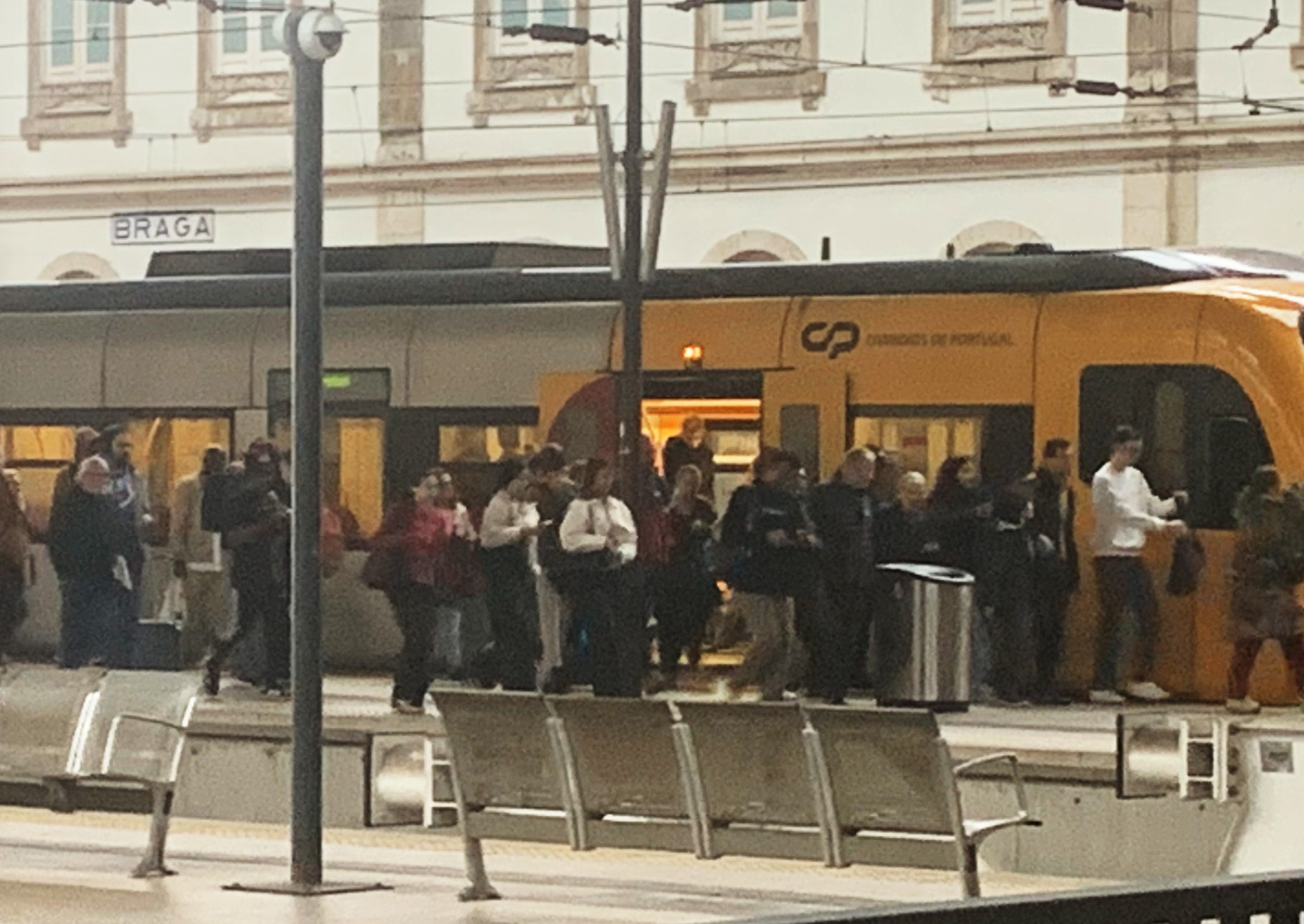
Pictured - the HOURLY train from Porto has just arrived in Braga and - oh look - the crowds are flowimg odd. It works!
| Re: Transfer of historic railway estate to GBR (aka full circle) In "Looking forward - the next 2, 5, 10 and 20 years" [381375/32667/40] Posted by eightonedee at 17:21, 27th October 2026 Already liked by Mark A, Oxonhutch | |
It was interesting to see how these members of the House of Lords could sit around the committee table, and (notwithstanding their different political allegiances) have a civilised and constructive discussion with a remarkable degree of cross-party agreement. Possibly it was easier for milords Young, Grayling and Harper to support this freed from the departmental and Treasury pressures of office?
But, notwithstanding Lord Hendy's commitment, it is difficult to see priority being given to the constructive re-use or devotion of much valuable resource to these assets if they do end up in GBR's ownership. I have had recent experience of dealing with CRT on a "legacy" site, and temper my disappointment with the slowness of their actions by the thought of the vast estate of current and former canal assets (quite a few of which carry considerable potential liability if something fails, as has happened on more than one occasion in recent years) for which they are responsible. I am not sure that moving assets from one balance sheet to another does much to help safeguard them in a world when cost is king, and there are many calls on resources.
| Re: Please help the Webmaster - how and where do you browse from? In "News, Help and Assistance" [381374/32656/29] Posted by grahame at 16:01, 27th October 2026 Already liked by Marlburian, Mark A | |
Many thanks for all the inputs. Whilst 100% of you visit from the UK ... at least some of the time ... there's a substantial number from time to time outside the UK and all sorts of technological elements too. Traffic has been very heavy of late, with numerous automated accesses failing to admit that they are automated - rather faking what type or browser that are, and doing in via all sorts of distributed places. I am saying "oy" to a number of these - purely to keep traffic down and prevent congestion / gridlock but they are so hard to identify ...
| Legal transfer of data - FIRST Great Western Ltd to Great Western Railway Ltd In "Across the West" [381373/32668/26] Posted by grahame at 14:19, 27th October 2026 | |
From my email ...
Hi Graham,
From the 13th of December, GWR will be operated by a new company Greater Western Railway Limited as part of a planned transition into public ownership. Although the legal operator is changing, you'll continue to see the same GWR, and the same teams running your trains.
Responsibility for your personal data will transfer from First Greater Western Limited to Greater Western Railway Limited. This is a legal change only - your data will continue to be handled in the same systems, by the same teams, and used for the same purposes.
You don't need to take any action now. The updated privacy notice for Greater Western Railway Limited will be published on the 13th of December.
Our reasons for collecting and using your data remain unchanged. The new operator will also have some additional responsibilities - such as the Freedom of Information Act - but these won't affect how your data is used day to day.
From the 13th of December, GWR will be operated by a new company Greater Western Railway Limited as part of a planned transition into public ownership. Although the legal operator is changing, you'll continue to see the same GWR, and the same teams running your trains.
Responsibility for your personal data will transfer from First Greater Western Limited to Greater Western Railway Limited. This is a legal change only - your data will continue to be handled in the same systems, by the same teams, and used for the same purposes.
You don't need to take any action now. The updated privacy notice for Greater Western Railway Limited will be published on the 13th of December.
Our reasons for collecting and using your data remain unchanged. The new operator will also have some additional responsibilities - such as the Freedom of Information Act - but these won't affect how your data is used day to day.
and
Questions
Why is my data being transferred?
The transfer ensures continuity of service with minimal impact on you. First Greater Western Limited is transferring your data in reliance on its legitimate interests (Article 6(1)(f) UK GDPR), having assessed that the transfer is necessary and fair so that services continue to run smoothly.
First Greater Western Limited’s privacy policy explains that your data may be passed to a successor operator if the franchise operations transfer.
What data is involved?
All personal data held by First Greater Western Limited in connection with rail services will be made available to Greater Western Railway Limited. This may include contact details, booking history, payment records, and customer service correspondence. It will only continue to be used for the same purposes it was originally collected for. Your data will continue to be held only as long as needed to deliver services and meet legal obligations.
What are my rights?
You still have the same rights under data protection law, including:
• The right to access your data
• The right to ask for corrections
• The right to object to processing based on legitimate interests
• The right to ask for deletion (in some circumstances)
• The right to restrict how your data is used
• The right to complain to the Information Commissioner's Office (ICO)
You can find out more about your rights at ico.org.uk.
You can find out more about programme to transfer rail services into public ownership and establish GBR as the body responsible for passenger services and infrastructure at gov.uk/guidance/great-british-railways.
To exercise your data rights before the 13th of December, please contact GWR at:
CONTACT DETAILS: GWR-DPO@gwr.com
POSTAL ADDRESS: MH101, GWR, Milford House, Swindon, SN1 1HL
Registered office: First Greater Western Limited, Milford House, 1 Milford Street, Swindon, Wiltshire, SN1
Why is my data being transferred?
The transfer ensures continuity of service with minimal impact on you. First Greater Western Limited is transferring your data in reliance on its legitimate interests (Article 6(1)(f) UK GDPR), having assessed that the transfer is necessary and fair so that services continue to run smoothly.
First Greater Western Limited’s privacy policy explains that your data may be passed to a successor operator if the franchise operations transfer.
What data is involved?
All personal data held by First Greater Western Limited in connection with rail services will be made available to Greater Western Railway Limited. This may include contact details, booking history, payment records, and customer service correspondence. It will only continue to be used for the same purposes it was originally collected for. Your data will continue to be held only as long as needed to deliver services and meet legal obligations.
What are my rights?
You still have the same rights under data protection law, including:
• The right to access your data
• The right to ask for corrections
• The right to object to processing based on legitimate interests
• The right to ask for deletion (in some circumstances)
• The right to restrict how your data is used
• The right to complain to the Information Commissioner's Office (ICO)
You can find out more about your rights at ico.org.uk.
You can find out more about programme to transfer rail services into public ownership and establish GBR as the body responsible for passenger services and infrastructure at gov.uk/guidance/great-british-railways.
To exercise your data rights before the 13th of December, please contact GWR at:
CONTACT DETAILS: GWR-DPO@gwr.com
POSTAL ADDRESS: MH101, GWR, Milford House, Swindon, SN1 1HL
Registered office: First Greater Western Limited, Milford House, 1 Milford Street, Swindon, Wiltshire, SN1
| Transfer of historic railway estate to GBR (aka full circle) In "Looking forward - the next 2, 5, 10 and 20 years" [381372/32667/40] Posted by Electric train at 14:11, 27th October 2026 Already liked by Mark A | |
"It is firmly a Government intention” to transfer the Historical Railways Estate to Great British Railways. That was the commitment made yesterday by Lord Hendy, the Minister of State for Rail, during his response to a debate around an amendment to the Railways Bill which is currently going through its Committee Stage.
https://www.youtube.com/watch?v=p6poAoRnMp8
| Good joined up support - freight, passenger services, govt policy, and our MP In "TransWilts line - Swindon, Chippenham, Westbury" [381371/32666/18] Posted by grahame at 14:00, 27th October 2026 Already liked by JohnM | |
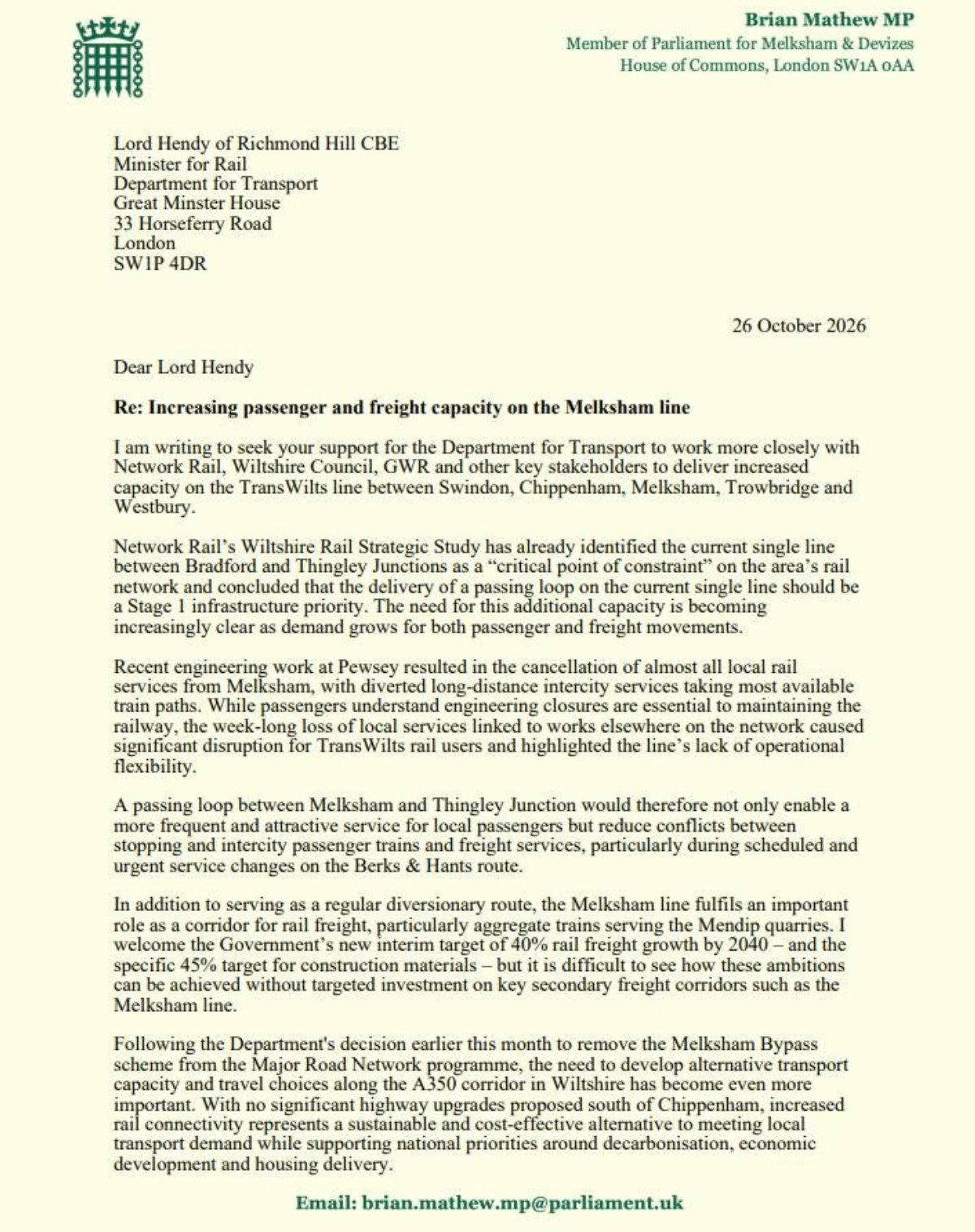
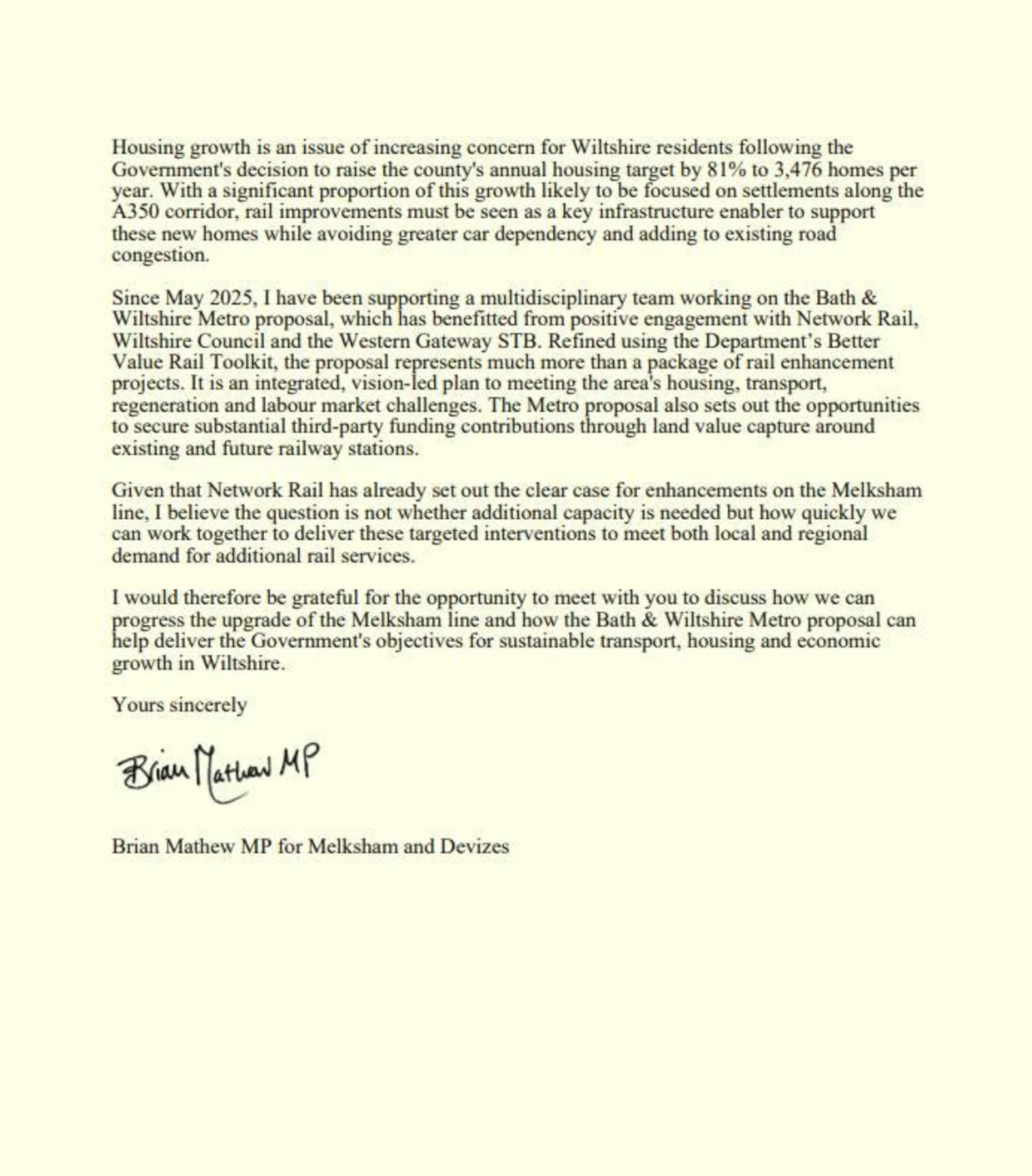
"Pulling the plug" - for however long - on the Melksham (and Westbury, and Beanacre bypasses) does not reduce the amount of freight travelling south-north through Wiltshire.
It helps make the case for transfer to rail - where that's appropriate, and furthermore it's far less intrusive, less locally controversial, far environmentally better, and far cheaper to put in the infrastructure for rail. If it can be done BEFORE our population explodes as planned, and with a "metro" frequency rail service in place ahead of time, then our economy and good housing stock will grow with people ready, willing AND ABLE to use rail where appropriate - and that in turn lessens the load and congestion on roads in the area from what it would otherwise be.
| Re: Historical Record Perception - Correction / Confirmation Required In "South Western services" [381370/32665/42] Posted by JohnM at 11:59, 27th October 2026 Already liked by Western Pathfinder | |
AI can be pretty good at this sort of thing, although it's not easy to tell whether it's correct or not:
Phil's historical recollection contains a mix of accurate details and a few misconceptions regarding the administration and operational changes of the line:
- The Regional Transfer (Incorrect): Phil suggests that control of the Salisbury to Exeter route was transferred from the Southern Region (BR(S)) to the Western Region (BR(W)) in the early 1960s, and that Western Region management deliberately throttled the Atlantic Coast Express (ACE) because they didn't want a competing fast route into the West Country. In reality, the entire line from Salisbury to Exeter remained under the management and control of British Railways' Southern Region right up until the major singling and rationalisation carried out in 1967 (well after the Beeching Report and after steam had ended on the route). Management control didn't shift to the Western Region until even later (the line was formally transferred to the Western Region in the 1970s, long after the singling cuts took place).
- The Beeching Cuts & Singling (Partially Correct): The reduction of the Wilton-Pinhoe section to predominantly single track was part of the wider post-Beeching rationalisation implemented in June 1967, rather than an immediate result of Beeching's original 1963 report itself. While local intermediate stations and branches (like Lyme Regis, Sidmouth, and Chard) were indeed closed under the Beeching axe, the decision to single the core line was driven by British Railways' financial and traffic-reduction policies of that era to save on maintenance costs, rather than an inter-regional conspiracy by Western Region management to handicap the ACE.
- The Atlantic Coast Express (Contextual Accuracy): The ACE was indeed a premier express service, and its timings and fortunes degraded sharply in the final years of steam and early dieselization due to general network economies, falling passenger numbers with the rise of private cars, and eventual rerouting/withdrawal, but this happened under Southern Region stewardship prior to the route's major truncation.
| Re: Can we contribute material to the Coffee Shop, please? In "Introductions and chat" [381369/32664/1] Posted by Richard Fairhurst at 11:56, 27th October 2026 Already liked by Western Pathfinder | |
I have a sentence on cycle.travel's "contact us" page saying "we don't accept sponsored posts, link exchanges or guest posts". Doesn't stop them incessantly trying. I just mark as junk and move on.
| Re: Historical Record Perception - Correction / Confirmation Required In "South Western services" [381368/32665/42] Posted by ChrisB at 11:53, 27th October 2026 Already liked by PhilWakely, johnneyw, Western Pathfinder | |
I have loved alongside the Waterloo to Exeter line in or near Pinhoe for all bar three years of my Seventy years
Love this! too much info maybe?

| Re: Historical Record Perception - Correction / Confirmation Required In "South Western services" [381367/32665/42] Posted by Richard Fairhurst at 11:53, 27th October 2026 | |
I'll try and find my copy later but Gerry Fiennes' "I Tried to Run a Railway" is very good on the decisions behind retention of the line. He was not impressed with the support forthcoming, or not, from local politicians.
| Historical Record Perception - Correction / Confirmation Required In "South Western services" [381366/32665/42] Posted by PhilWakely at 11:36, 27th October 2026 | |
I have lived alongside the Waterloo to Exeter line in or near Pinhoe for all bar three years of my Seventy years and have always been interested in the fortunes of the line. My A-Level Statistics project, which gained an A grade was on the subject of 'Re-doubling the railway between Wilton and Pinhoe'.
However, one significant event in the history of the line puzzles me and I'd like confirmation or correction of my memory please.
Every article I read on the reasons for reducing Wilton South to Pinhoe to mainly single track and thus the route to Secondary status, was down entirely to Dr Beeching. However, my recollection is that was only the beginning - with the closure of several intermediate stations. My recollection is that control of the Salisbury to Exeter route was transferred from BR(S) to BR(W) in the early 60s and that Senior Management of BR(W) did not want two fast routes into the westcountry (the ACE was faster to Exeter than the Cornish Riviera at the time). So, BR(W) throttled the ACE in the timetable and made the decision to reduce the route to Secondary status.
Can somebody confirm / correct my perception please?
*** Correction of unfortunate typo in the first sentence ***
| Re: North Cotswold line delays and cancellations - 2026 In "London to the Cotswolds" [381365/31371/14] Posted by charles_uk at 10:07, 27th October 2026 | |
Cancellations to services between Oxford and Worcester Shrub Hill
Due to a tree blocking the railway between Honeybourne and Evesham the line is blocked. Disruption is expected until 10:30 27/10.
Train services between Oxford and Worcester Shrub Hill may be cancelled or delayed.
Customer Advice
-
What has happened?
-
There is a tree blocking the railway line between Honeybourne and Evesham.
-
What are we doing about it?
-
Network Rail are sending a specialist team to site to clear the tree.
Due to a tree blocking the railway between Honeybourne and Evesham the line is blocked. Disruption is expected until 10:30 27/10.
Train services between Oxford and Worcester Shrub Hill may be cancelled or delayed.
Customer Advice
-
What has happened?
-
There is a tree blocking the railway line between Honeybourne and Evesham.
-
What are we doing about it?
-
Network Rail are sending a specialist team to site to clear the tree.
| Re: Oxford Street, London has been pedestrianised In "Active travel: Cyclists and walkers, including how the railways deal with them" [381364/32663/50] Posted by GBM at 09:45, 27th October 2026 | |
Having walked up Oxford Street myself earlier and spent the day in the area I can confirm it's chaotic.....buses roaring around side streets which were never designed for them, smaller shops which rely on daily deliveries struggling (no problem for the likes of John Lewis with warehouses) and traffic backing up everywhere.
Mayor Lord Sir Khan has excelled himself on this one. Solved one problem by creating a dozen others.
One thing I did find quite amusing walking back to the Tube station tonight, despite pedestrianisation everyone still walking on the pavements!
Roger French also did some walking -Mayor Lord Sir Khan has excelled himself on this one. Solved one problem by creating a dozen others.
One thing I did find quite amusing walking back to the Tube station tonight, despite pedestrianisation everyone still walking on the pavements!
https://busandtrainuser.com/2026/10/27/how-to-ruin-five-more-central-london-bus-routes/
It’s finally happened. After years of controversy with Westminster Council and others objecting, Mayor Kahn’s vision for a traffic free Oxford Street, first launched in his 2016 manifesto, finally got under way yesterday when the 900 yard middle section, between Great Portland Street and Selfridges, of the 1.2 mile long road was pedestrianised with not even cycles allowed to use the road.
I blogged about this proposal two years ago expressing concern at the impact on passengers using the busy bus stops served by the five TfL routes still using the street – routes 7, 94, 98, 139 and 390.
............continues...........
| Re: Bus deregulation - on this day 26th October 1986 In "Buses and other ways to travel" [381363/29361/5] Posted by GBM at 09:41, 27th October 2026 Already liked by Mark A | |
Roger French article here -
https://busandtrainuser.com/2026/10/25/marking-40-years-of-deregulated-buses/
Sunday 25th October 2026
To mark tomorrow’s 40th Anniversary of bus deregulation here’s an article I wrote earlier this year for the Omnibus Magazine (the bi-monthly magazine of the Omnibus Society) explaining why deregulation worked so well in Brighton and Hove as well as a number of other British towns and cities. It perhaps also explains why deregulation manifestly didn’t work in other places most of which are now first in the queue for implementing the now available alternative of politically led and publicly controlled ‘franchising’, thanks to previously unheard of generous funding from Government.
.....continues..........
| Re: Swindon <-> Westbury service updates and amendments, ongoing discussion - 2026 In "TransWilts line - Swindon, Chippenham, Westbury" [381362/31359/18] Posted by TaplowGreen at 09:29, 27th October 2026 | |
09:45 Westbury to Swindon due 10:28
09:45 Westbury to Swindon due 10:28 will be cancelled.
This is due to train crew being delayed by service disruption.
| Re: Bus deregulation - on this day 26th October 1986 In "Buses and other ways to travel" [381361/29361/5] Posted by grahame at 09:28, 27th October 2026 | |
As a dispassionate outsider to Melksham, but temporarily residing here, I have to say that I am becoming a great fan of the Faresaver bus services here.
I have travelled from Melksham Market Place into Bath - service 272 in particular - and to Chippenham - service X34 even goes direct to the railway station there.
I have found those buses to be far more reliable than the sometimes rather flaky train services to and from Melksham.
Chris from (temporarily) Melksham.
I have travelled from Melksham Market Place into Bath - service 272 in particular - and to Chippenham - service X34 even goes direct to the railway station there.
I have found those buses to be far more reliable than the sometimes rather flaky train services to and from Melksham.
Chris from (temporarily) Melksham.
"ish" - a handful of early Monday to Saturday service call at the station in Chippenham having left from Melksham, and a few mid to late afternoon service to Melksham call there. Otherwise on Monday to Saturday, they don't. All Sunday service to Chippenham will call at the station ON REQUEST, and all outbound services call there.
For Melksham resident "in the know", it works fine as those are the most useful services for rail transfer; what we are short of is evening bus services from (any part) of Chippenham to Melksham.
| Re: Swindon <-> Westbury service updates and amendments, ongoing discussion - 2026 In "TransWilts line - Swindon, Chippenham, Westbury" [381360/31359/18] Posted by grahame at 09:21, 27th October 2026 | |
08:44 Swindon to Westbury due 09:26
08:44 Swindon to Westbury due 09:26 has been cancelled.
This is due to the emergency services dealing with an incident.
08:44 Swindon to Westbury due 09:26 has been cancelled.
This is due to the emergency services dealing with an incident.
| Re: Can we contribute material to the Coffee Shop, please? In "Introductions and chat" [381359/32664/1] Posted by grahame at 09:20, 27th October 2026 | |
That's an agency trying to find outlets that they can *sell* to their 'clients'. Not that you'll get any money out opf it, and if its free, neither will they, and you won't get any content being supplied.
Don't waste your timer responding would be my suggestion.
Don't waste your timer responding would be my suggestion.
You are almost certainly right. However, having a standard answer to hand and in public I can now just say "see here" to the various requests received, occasional ones of which have resulted in one post wonders. Answer not just (or even really) for this enquirer, but far more general. Next time it's quicker, and, further, guests / casual visitors who may have wondered are encouraged to join and post.
| Re: Can we contribute material to the Coffee Shop, please? In "Introductions and chat" [381358/32664/1] Posted by ChrisB at 08:52, 27th October 2026 Already liked by Richard Fairhurst | |
That's an agency trying to find outlets that they can *sell* to their 'clients'. Not that you'll get any money out opf it, and if its free, neither will they, and you won't get any content being supplied.
Don't waste your timer responding would be my suggestion.
| Re: To 'stockpile food' is now our Government's official policy, apparently In "The West - but NOT trains in the West" [381357/32456/31] Posted by broadgage at 08:43, 27th October 2026 | |
It would seem that a significant number of people ARE stocking up on essentials as suggested by HMG.
https://www.bbc.co.uk/news/articles/c5rmy84np001o
Proper "doomfood" would IMHO be preferable to regular tinned food as it has a warranted 25 year shelf life and should last almost forever.
Needs extra water and means of boiling same though.
