









| Weather updates from overseas and implications for infrastructure - 2026 Posted by Chris from Nailsea at 20:38, 20th March 2026 |     |
From BBC Weather:
Tenerife hit by snow as Storm Therese brings wind and rain to Canary Islands
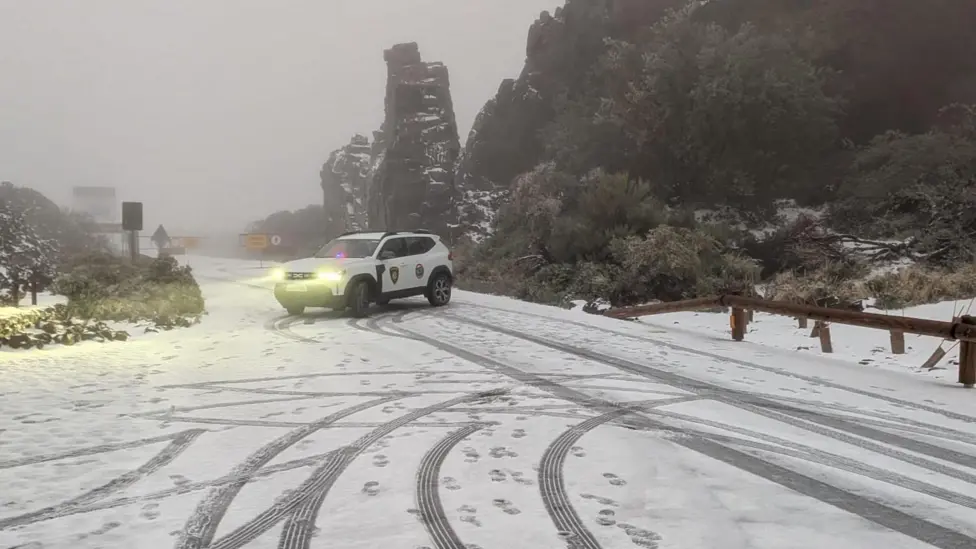
Authorities in Tenerife have activated emergency plans as Storm Therese brings wet, windy and wintry weather to the Canary Islands.
Outdoor events have been called off, roads are closed and some flights have been cancelled with weather warnings set to stay in force throughout the weekend.
Significant snow has already fallen over high ground in the centre of the island around the Mount Teide volcano. Heavy rain will bring the threat of flooding while strong winds and rough seas will also pose a hazard.
Storm Therese was named by the Portuguese weather service earlier this week - largely because of the risk of disruption in Madeira and the Azores. However the Canaries are now bearing the brunt.
The Spanish weather service, AEMET, has issued orange weather warnings for Tenerife, valid throughout Friday and into Saturday. Northern areas of the island could see wind gusts of 90-100 km/h (56-62mph).
The southern half of Tenerife is covered by a warning for rain, with the potential that 100mm (4 in) could fall in some places over a 12 hour period. This intense rainfall will bring the risk of flooding, landslides and transport disruption.
The Tenerife Island Council - the Cabildo de Tenerife - activated its emergency plan on Wednesday, warning locals and visitors to exercise caution and to avoid unnecessary travel. Temporary shelters have been set up in affected areas and access roads to the Teide National Park have been closed.
(BBC article continues)
Authorities in Tenerife have activated emergency plans as Storm Therese brings wet, windy and wintry weather to the Canary Islands.
Outdoor events have been called off, roads are closed and some flights have been cancelled with weather warnings set to stay in force throughout the weekend.
Significant snow has already fallen over high ground in the centre of the island around the Mount Teide volcano. Heavy rain will bring the threat of flooding while strong winds and rough seas will also pose a hazard.
Storm Therese was named by the Portuguese weather service earlier this week - largely because of the risk of disruption in Madeira and the Azores. However the Canaries are now bearing the brunt.
The Spanish weather service, AEMET, has issued orange weather warnings for Tenerife, valid throughout Friday and into Saturday. Northern areas of the island could see wind gusts of 90-100 km/h (56-62mph).
The southern half of Tenerife is covered by a warning for rain, with the potential that 100mm (4 in) could fall in some places over a 12 hour period. This intense rainfall will bring the risk of flooding, landslides and transport disruption.
The Tenerife Island Council - the Cabildo de Tenerife - activated its emergency plan on Wednesday, warning locals and visitors to exercise caution and to avoid unnecessary travel. Temporary shelters have been set up in affected areas and access roads to the Teide National Park have been closed.
(BBC article continues)
| Re: Weather updates from overseas and implications for infrastructure - 2026 Posted by Chris from Nailsea at 18:56, 28th June 2026 | |
From the BBC:
Europe's heatwave linked to 1,300 deaths, WHO says, as Germany hits record 41.7C
Europe's unprecedented early summer heatwave may be responsible for hundreds of excess deaths, according to the head of the World Health Organization (WHO).
Temperature records were broken across the continent again on Sunday – including in Germany, Poland and the Czech Republic – as the extreme heat continued to move east.
In a post on X, WHO chief Tedros Adhanom Ghebreyesus said more than 1,300 excess deaths had been recorded since 21 June "linked to high temperatures in Europe".
"Heat stress is often called the 'silent killer' - and European homes, workplaces and schools were not built for these temperatures," he said.
On Sunday morning, France's national health ministry said there had been around 1,000 more deaths than expected in the country since Wednesday. Many of the extra fatalities are among those aged 65 over, the agency said, after logging a 40% rise in the number of people dying at home.
"Europe is the fastest-warming continent on Earth, heating at twice the global average," Tedros warned. Millions of people across the continent are currently "living under extreme heat, hundreds have died, schools are shut, grids are buckling", he added.
On Sunday, Germany experienced its hottest-ever day for the third consecutive day after 41.7C was recorded in the east of the country, preliminary data showed. A station in Coschen, near the Polish border in eastern Brandenburg, recorded 41.7C at around 16:00 local time.
The Czech Republic set its second temperature record in two days, recording 41.1C at Doksany, north of Prague, the meteorological institute CHMI said. CHMI said it expected the heat to peak on Sunday, with rather heavy storms forecast for western areas later.
Poland also broke its all-time temperature record with 40.5C in the town of Slubice, a spokeswoman for the Institute of Meteorology and Water Management (IMGW) told the AFP news agency on Sunday.
Climate change was responsible for the extreme weather, Tedros said, warning that Europe was warming at "twice the global average".
"Driven by climate change and global warming, the phenomenon of the 'once-in-a-generation' heatwave is now occurring nearly annual," he said. He called on European countries to "implement heat health action plans", as part of a push to safeguard health in the face of climate change.
Europe's unprecedented early summer heatwave may be responsible for hundreds of excess deaths, according to the head of the World Health Organization (WHO).
Temperature records were broken across the continent again on Sunday – including in Germany, Poland and the Czech Republic – as the extreme heat continued to move east.
In a post on X, WHO chief Tedros Adhanom Ghebreyesus said more than 1,300 excess deaths had been recorded since 21 June "linked to high temperatures in Europe".
"Heat stress is often called the 'silent killer' - and European homes, workplaces and schools were not built for these temperatures," he said.
On Sunday morning, France's national health ministry said there had been around 1,000 more deaths than expected in the country since Wednesday. Many of the extra fatalities are among those aged 65 over, the agency said, after logging a 40% rise in the number of people dying at home.
"Europe is the fastest-warming continent on Earth, heating at twice the global average," Tedros warned. Millions of people across the continent are currently "living under extreme heat, hundreds have died, schools are shut, grids are buckling", he added.
On Sunday, Germany experienced its hottest-ever day for the third consecutive day after 41.7C was recorded in the east of the country, preliminary data showed. A station in Coschen, near the Polish border in eastern Brandenburg, recorded 41.7C at around 16:00 local time.
The Czech Republic set its second temperature record in two days, recording 41.1C at Doksany, north of Prague, the meteorological institute CHMI said. CHMI said it expected the heat to peak on Sunday, with rather heavy storms forecast for western areas later.
Poland also broke its all-time temperature record with 40.5C in the town of Slubice, a spokeswoman for the Institute of Meteorology and Water Management (IMGW) told the AFP news agency on Sunday.
Climate change was responsible for the extreme weather, Tedros said, warning that Europe was warming at "twice the global average".
"Driven by climate change and global warming, the phenomenon of the 'once-in-a-generation' heatwave is now occurring nearly annual," he said. He called on European countries to "implement heat health action plans", as part of a push to safeguard health in the face of climate change.
